AI Affiliate Workshop Review
Watching Chris Derenberger Build Affiliate Sites With ChatGPT, And What The Course Leaves To You
Why Watching Someone Work Beats Another Ebook
Most affiliate training tells you what to do. Very little of it shows you. You get a PDF of tips, a list of tools and a promise that it all clicks once you start, and then you open ChatGPT, type something vague and get something vague back.
Watching a person do the job is different.
AI Affiliate Workshop is built on that idea. Chris Derenberger’s course launches on November 17, 2026 through WarriorPlus, and the price is $47 one time for six video lessons and a bonus video in which he uses ChatGPT to research products, build interactive affiliate pages, put together a full review site and make an affiliate video. There are no upsells.
That’s refreshingly simple. The catch is that the course is only the training. The work happens inside a paid ChatGPT plan, the hosting it relies on is changing its billing in January, and every affiliate program you touch has rules of its own.
This review covers the seven videos in order, the real running cost, the hosting question, the Amazon, Google and disclosure rules that matter for AI-built review sites, the conditional refund and what I could and couldn’t check before the cart opened. I’m leaving out every earnings figure.
AI Affiliate Workshop Quick Facts

| Detail | Information |
|---|---|
| Product | AI Affiliate Workshop |
| Vendor | Chris Derenberger |
| Launch | November 17, 2026, 9:00 AM EST |
| Sold through | WarriorPlus |
| Sales Page | https://aiaffiliateworkshop.com |
| Category | AI affiliate marketing video course |
| Type | Online video training with a member area |
| Front-end price | $47 one-time, shown against a crossed-out $97 |
| Upsells | None |
| Refund | 7 days, with a specific reason required |
Seven Videos, One Prompt And A Comment Box
Strip the sales page back and here’s what you’re buying.
- Six core lessons: screen recordings of Chris working in ChatGPT on real affiliate projects.
- A bonus lesson: turning a product into an affiliate video, included with a purchase made at launch.
- A product research prompt: a copyable prompt for digging into a product before you write about it.
- Lesson discussions: a comment area under each video where members ask questions and read his replies.
That’s the whole package. There’s no software, no plugin and no done-for-you site. You watch what he types, what ChatGPT produces and how he asks for changes, and then you repeat the process with your own products.
The worked example is WattRoster, his own affiliate review site. The sales page displays its home page, its product cards with photos and affiliate buttons, and its detailed reviews. He says he gave AI the instructions, reviewed the work and asked for changes. That framing matters, because the reviewing and the changing are the part a beginner tends to skip.
The course claims to work with any affiliate network. Amazon Associates, ClickBank, WarriorPlus, JVZoo, Awin, CJ and Impact are named, along with physical products, digital products, software and services. That’s believable for a method course, since the technique is the same whatever you promote. The rules aren’t the same, and I’ll come to those.
Meet Chris Derenberger
Chris Derenberger is an internet marketer, software developer and website builder who says he’s worked in affiliate marketing for more than 20 years and full time since 2013.
He has released a long list of marketing and AI products, including Thumbium, an AI thumbnail tool, along with AIWiseMind, eBook Writer AI, MedPoster AI, AIBizly, YT Supremacy and AI Affiliate Suite. That track record suggests he knows how to ship, though I can’t verify how each product has aged, so I’d judge this one by the lessons themselves and by how he answers questions in the discussion threads.
Six Lessons And A Bonus, In The Order They Play
Here’s the course as it runs, video by video, written as I’d work through it.
Step 1: Intro to AI Affiliate Workshop
I start here. Chris gives a tour of the workshop and shows how he uses ChatGPT for the work behind his affiliate business. It’s the map before the journey, and it sets the expectation that I’ll be copying a process, not installing a tool. I’d use this video to decide whether his way of working suits mine. If the pace or the style grates here, six more lessons won’t change that, and the refund clock is already running.
Step 2: ChatGPT Browser
Next I watch him give ChatGPT instructions, work with websites and check what it finds. The useful bit is how he asks for changes when the first result misses. Most people stop at the first answer, and this lesson is about not doing that. It’s also where I’d start noting his phrasing, since the way he words a correction is the skill being taught. A browsing assistant can read a page wrongly or miss a detail, so I’d watch how often he double-checks what it reports.
Step 3: Using Amazon Products
I follow him as he finds Amazon products and uses the listing details to research them. Then I see the exact requests he gives ChatGPT to turn that research into affiliate content. This is where the copyable research prompt earns its keep. I’d run it on a product I already own first, so I can tell straight away when the output gets something wrong.
Step 4: Interactive Affiliate Pages
Here he builds a page that asks visitors questions and points them to a matching product, a quiz-style finder. I watch it take shape as he tells ChatGPT what he wants, and I learn how to match a page like that to a particular offer. Finder pages are more engaging than a plain list, and they also hide the affiliate relationship more easily, so I’d plan the disclosure on the results screen from the start.
Step 5: Promoting ClickBank Products
I switch from physical products to a ClickBank offer. Chris uses the product information to have ChatGPT build out a dedicated product website, which shows the same process working on a digital product. The difference is the material. A ClickBank sales page is marketing copy, so whatever ChatGPT builds from it needs a much harder edit than a page built from a product’s specification sheet.
Step 6: Building an Affiliate Website
This is the main event. A complete affiliate website comes together on screen, and I see every instruction he gives and every change he asks for as the pages are built and reviewed. It’s the lesson the WattRoster screenshots point to. I’d pause it often. The value sits in the small requests, such as fixing a layout, rewording a heading or adding a comparison, because those are the moves I’ll repeat on every page I build afterwards.
Step 7: Affiliate Videos Using ChatGPT and AI
The bonus lesson turns a product into an affiliate video. I watch him use ChatGPT and other AI tools, work with the narration and assemble the result in an editor. It’s included with a purchase made at launch, and the page frames it as a reason to buy today. I’d want to know which video and voice tools he uses beyond ChatGPT, because those may carry their own subscriptions.
The sales page’s own summary of all this is three verbs: watch the examples, give better instructions, use it in your business.
To see the platform in action, be sure to check out the full demo video below:
Letting ChatGPT Browse Without Getting Burned
The second lesson puts ChatGPT to work on live websites. A browsing assistant is genuinely handy for research. It can open a product page, read the specifications, compare a few listings and summarize what it saw while you get on with something else.
It also brings risks that ordinary chat doesn’t.
- Wrong readings: pages change, prices load late and tables confuse it, so a confident summary can still be wrong.
- Hidden instructions: a web page can contain text aimed at AI assistants, trying to steer what they say or do. Keep an eye on anything that looks off.
- Logged-in accounts: I wouldn’t let an assistant act inside an affiliate dashboard, a payment account or an email inbox without watching every step.
- Spending: never let it buy anything or sign up for anything on your behalf unless you’ve approved that exact action.
- Terms of use: some sites don’t allow automated access, and a few block it outright.
Treat it like a fast, eager assistant on its first week. Useful, quick and in need of supervision. Check its findings against the page yourself before any of them reach a published review.
Prompting Habits Worth Taking From The Lessons
The course sells itself on watching the exact requests Chris makes, and that’s the most transferable part. I can’t see the paid videos, so these are the habits the sales copy points to, along with the ones I would build anyway.
Say who the page is for. A review written for a first-time buyer reads differently from one written for an enthusiast. Tell ChatGPT the reader, the problem and the budget before you ask for a word.
Give it the facts. Paste the specifications, the warranty terms and your own notes. A model that has to guess will guess confidently.
Ask for one change at a time. Fix the layout, then the headline, then the comparison table. Bundled requests tend to break something that was already fine.
Name what’s wrong. Too salesy, too long, the second section repeats the first. Specific complaints get specific fixes.
Keep a library. When a request works well, save it. After a few weeks you’ll have a set of prompts that fits your niche better than anything you can buy.
Read the output aloud. It’s the quickest way to hear filler, odd claims and sentences nobody would say.
Picking A Niche You Can Stand Behind
The course leaves the choice of products and niche to you, which is right, since that choice decides more than any prompt does. A few filters I’d apply before building a single page.
- Something you know: you’ll spot the AI’s mistakes faster in a field you understand, and readers can tell.
- Products you can touch: even a few hands-on reviews lift a site above pages built from listings.
- Low harm if wrong: kitchen gadgets and camping gear forgive an error. Supplements, medical devices and financial products don’t.
- Several programs: a niche where brands run their own affiliate programs isn’t hostage to one network’s rules.
- Room to be useful: if the top results are already excellent, pick a narrower corner.
WattRoster, the course example, appears to sit in a practical product category where specifications matter and comparisons help. That’s a sensible template. Copying its exact niche isn’t, because every buyer of the course will be tempted to do the same.
The Running Cost Hiding Behind $47
The course is $47. Following it isn’t.
The sales page, the terms and the refund policy all say you’ll need at least ChatGPT Plus, bought separately at $20 monthly. Domain names are extra if you want your own. To its credit, the vendor repeats this everywhere, even inside the affiliate swipe emails, and asks promoters to keep it clear. That’s unusually honest for a launch.
Here’s what a year looks like on the plan the course requires.
| Item | Cost |
|---|---|
| AI Affiliate Workshop | $47 once |
| ChatGPT Plus | $20 monthly, so $240 over twelve months |
| A domain name | Optional, usually a modest yearly fee |
| Hosting | Included with ChatGPT Plus for now, see below |
So the realistic first-year outlay is closer to three hundred dollars than to forty-seven. That’s still cheap for a working toolset. It’s just a different number from the one on the button.
There’s a second point hiding in the refund rules. Forgetting about the ChatGPT requirement isn’t grounds for a refund. If you don’t already pay for Plus, decide whether you’ll keep paying for it before you buy the course, not after.
ChatGPT Sites, Hosting And The January Change
The course says the ChatGPT Plus plan includes the website hosting used in the lessons. That lines up with ChatGPT Sites, the feature that lets ChatGPT build, publish and host a website or small app from a description. Sites is available on Plus and Pro plans and on business workspaces.
That’s a genuine convenience. No separate host, no file uploads, no server setup. You describe the site, review it, publish it and point a domain at it if you like.
The fine print matters for anyone building a long-term affiliate asset.
- Hosting is free until December 31, 2026: from January 1, 2027, Plus users pay for hosting use above a shared monthly allowance of 125 credits.
- Building uses your allowance: creating and editing a Site counts toward your Codex usage on the plan.
- Traffic adds up: each page visit can generate dozens of requests, and those draw on the hosting allowance.
- It’s a beta: usage limits may change, and reaching one can stop a busy Site from staying public.
- Regional gaps: at launch, Sites wasn’t available everywhere, and parts of Europe and the UK were left out.
- A runtime with limits: some frameworks, databases and hosting patterns aren’t supported.
None of that kills the method, and a small review site with modest traffic will likely sit comfortably inside the allowance for a long time to come. But an affiliate site you hope to run for years is a business asset, and keeping it on a beta feature you can’t easily move is a risk. I’d keep copies of the content, the images and the page structure outside ChatGPT, so a move to ordinary hosting would take an afternoon and not a rebuild.
Amazon Associates Rules That Trip Up AI Sites
Two of the six lessons lean on Amazon, and Amazon’s Associates program has rules that AI-built sites break easily.
Prices. Amazon doesn’t let you show a product price unless it comes through its official product feed and stays current. A price typed into a review by ChatGPT goes stale within days, and stale prices can cost you the account.
Images. Product photos generally need to come through Amazon’s approved tools or its product feed. Copying images off listing pages is a common way to get flagged. Ask how the product cards on WattRoster get their photos before you copy the approach.
Disclosure. Amazon requires a clear statement that you earn from qualifying purchases, placed where readers will see it.
Content. Listing details are a starting point, and paraphrasing a listing isn’t a review. Amazon expects your site to offer something of its own.
Staying active. New Associates accounts must make qualifying sales within a set window or they’re closed, and access to the product feed depends on recent sales too. A brand-new site can sit in that gap for a while.
I don’t know how much of this the lessons cover, because the paid videos are behind the login. The disclaimer does put compliance with affiliate programs squarely on you, so read the operating agreement yourself before the first page goes live.
Review Content Google Still Rewards
The course promises detailed product reviews and automated new content. That’s where search engines come in, because most affiliate sites still depend on Google for visitors.
Google has said plainly that it doesn’t mind AI-written content as such. What it targets is scaled content abuse, meaning many pages produced mainly to rank and not to help readers, whatever tool made them. Its guidance on reviews asks for things a language model can’t supply alone: evidence you used the product, original photos, measurements, comparisons and honest drawbacks.
That puts a review site built entirely from listing details in an awkward spot. ChatGPT can summarize specifications beautifully. It can’t tell anyone how a power bank feels after a week in a backpack.
What I’d add to whatever the lessons teach:
- First-hand detail: buy or borrow at least some of the products and photograph them yourself.
- Fewer, better pages: ten useful reviews beat a hundred thin ones.
- Fact checks: confirm every specification against the maker’s own page.
- Dates: show when a review was updated, and update it.
- A real author: a name, a short bio and a reason to trust the opinion.
The automation lesson is the one to treat carefully. Automating research is sensible. Publishing automatically is how sites end up full of pages nobody reads and Google quietly ignores.
Disclosure Duties For Pages, Quizzes And Videos
Affiliate marketing runs on trust, and regulators care about it. In the US, the Federal Trade Commission expects a clear disclosure wherever a recommendation carries a financial link, close to the link itself, not buried in a footer. The course’s own affiliate disclosure page makes the same point, and suggests plain wording near every recommendation.
Each format the course teaches has its own wrinkle.
- Review pages: put the disclosure near the top and beside buttons, and keep it readable on a phone.
- Interactive finder pages: a quiz that recommends a product is still a recommendation, so the disclosure belongs on the results screen.
- ClickBank product sites: a site built around one offer can look like the vendor’s own page, so make it obvious that it’s an independent review.
- Affiliate videos: say it out loud and in the description, and use the platform’s paid promotion setting where it applies. Realistic AI voices or faces call for the platform’s AI label too.
Getting this right is cheap. Getting it wrong can mean a closed affiliate account or worse.
Affiliate Videos On YouTube And TikTok
The bonus lesson adds video, and video platforms have rules of their own.
Paid promotion. YouTube asks creators to tick a paid promotion box when a video carries a paid relationship, and TikTok has a similar content disclosure setting. Mention it out loud as well.
AI labels. Both platforms ask creators to label realistic synthetic content, such as an AI voice that sounds human or footage that looks real. A narrated product video with an AI voice may need it.
Repetition. YouTube’s policies on repetitive and mass-produced content target channels that post many near-identical videos. A template video swapped from product to product sits close to that line.
Links. Tracked links in descriptions are allowed on YouTube with disclosure. Some programs, Amazon included, have their own rules on where and how links appear.
One honest, specific video beats ten that look the same.
ClickBank Offers And The Claims You Inherit
Lesson five builds a site for a ClickBank product. ClickBank is a marketplace full of health, money and self-help offers, and many of their sales pages make bold claims. When an AI turns that sales copy into your review, it carries the claims across with it.
That’s the trap. You’re responsible for what you publish, and so is the vendor, and regulators don’t accept that a chatbot wrote it. Weight-loss promises, income claims, cure claims and fake urgency all deserve deleting.
My rule of thumb: if you wouldn’t say it to a friend over coffee, cut it from the page. Pick offers with sensible sales pages and decent refund records, and write about who the product isn’t for as clearly as who it is.
Price, Checkout Timing And The Missing Coupon
The order button sits under $47 one time, against a crossed-out $97 described as a $50 saving. The file I was given also says $47, so the figures agree. Treat the $97 as an anchor. Nobody pays it.
The WarriorPlus order form wasn’t open when I looked. It said the offer becomes available on November 17, 2026 at 8:00 AM US Central Time, which is 9:00 AM Eastern and matches the launch time on the partner page. The coming-soon page counts down to 8:00 AM Eastern, an hour earlier, so expect a short gap where the site is live and the button isn’t.
Coupons
There’s no coupon. The file I was given says no, there’s none on the sales page, and nothing on the site hints at one. Because the order form wasn’t selling yet, I couldn’t run guessed codes against a made-up control code the way I normally do, so treat that as untested rather than disproved. With no upsells and a single price, a coupon would be unusual here anyway.
| Item | Price |
|---|---|
| AI Affiliate Workshop | $47 one-time |
| Bonus video lesson | Included with a launch purchase |
| Upsells | None |
A Seven-Day Refund With Strings Attached
This is the part to read twice. The refund window is seven days, and it isn’t a no-questions guarantee.
- Email within seven days: include your purchase email, WarriorPlus transaction ID, purchase date and a detailed reason.
- Each request is reviewed: sending one doesn’t guarantee approval.
- Change of mind doesn’t count: the policy says so in plain words.
- Forgetting ChatGPT doesn’t count: not realizing a separate subscription is needed isn’t accepted.
- Access ends: an approved refund removes course access.
The reasoning is stated openly. It’s a training course with full access from day one, and knowledge can’t be returned. That’s fair as far as it goes, and it’s clearly disclosed, which I respect. It’s still much tighter than the thirty-day, no-reason guarantees common on WarriorPlus, and the policy notes that it doesn’t limit any legal rights you already have.
In practice: watch the intro and one full lesson on day one, and decide quickly.
No Upsells, No Bundle, No Order Bump
There’s no upgrade ladder here. No upsells is printed beside the buy button, and the partner page repeats it. The file I was given also lists no upgrades and no bundle.
I couldn’t see the order form itself before launch, so I can’t confirm the absence of an order bump on it, though nothing on the site describes one.
A single-price course with no funnel is rare in this market, and it changes the maths. What you see is what you pay, apart from ChatGPT.
Free Tutorials Versus A Paid Walkthrough
A fair question: why pay for this when there are hundreds of free videos about building sites with ChatGPT?
Free tutorials are often good, but they tend to show one tidy example, skip the messy corrections and stop right before the hard part, and many are made by people selling something else or go stale within weeks as ChatGPT changes.
What the workshop offers in return is a single affiliate marketer’s full workflow on real projects, from research to finished pages, with a place to ask him questions under each lesson. That’s worth paying for if you learn best by watching someone experienced work, and it’s less valuable if you’re happy piecing a method together from scattered videos online.
The honest comparison is time. If $47 saves you a few weekends of trial and error, it pays for itself in hours. If you already build with ChatGPT confidently, most of the course will feel familiar.
Who Gets The Most From It, And Who Should Skip
| Buyer | Fit |
|---|---|
| A beginner who already pays for ChatGPT Plus | Good, since the main extra cost is already covered |
| An affiliate who writes everything by hand | Good, for learning how to hand research and drafting to AI |
| Someone wanting a ready-made site | Poor, because nothing is built for you |
| A buyer on a tight budget without Plus | Think twice, given the monthly plan and the strict refund |
| An experienced AI user | Mixed, since the techniques may already be familiar |
| Anyone in a region without ChatGPT Sites | Check first, as the hosting method may not apply |
Good Calls And Weak Spots
What Worked
- One price: no upsells, no bundle, no surprise ladder.
- Honest requirements: the ChatGPT cost is repeated everywhere.
- Real projects: a live review site, an interactive finder and a ClickBank site.
- Process over hype: you see the requests and the corrections as well as the result.
- A useful extra: the research prompt and lesson discussions add practical help.
- Clean disclaimers: no promises of income, traffic or rankings.
What Didn’t
- A tight refund: seven days, a reason required and no change-of-mind refunds.
- Ongoing cost: the course depends on a monthly plan.
- Beta hosting: a free period that ends with the year.
- Compliance left to you: Amazon, Google and disclosure rules sit outside the sales pitch.
- Short content: six lessons plus a bonus is modest for anyone wanting depth.
- Untested order form: the cart wasn’t open when I looked.
Where The AI Does The Work Promise Needs A Reality Check
The tagline reads your products, your ideas, AI does the work. Here’s where I’d slow down.
AI does the work. It does the drafting. Choosing products, checking facts, taking photos and earning trust remain yours.
Complete affiliate websites. A site that looks complete and a site that ranks are different things, and the second takes months.
Automated new content. Automating research is smart. Automated publishing is the fastest route to thin pages.
Works with any network. The technique does. Each network’s rules on prices, images, claims and disclosure don’t bend to suit it.
Hosting included. True on ChatGPT Plus today, with charges above an allowance arriving in January and limits that may change.
No experience needed. You can follow along, yes. Spotting a wrong specification or a risky health claim takes judgment the course can show and can’t hand over.
Save $50 today. The crossed-out price is an anchor, not a past selling price anyone paid.
In fairness, the site carries a plain earnings disclaimer, a clear statement of the extra costs and an honest refund policy. Those read like the real terms, and they’re better than most.
Questions To Email Chris First
Support runs through a single email address, so ask before you buy, while the seven days haven’t started.
- How long is each lesson? Total running time tells you how much depth to expect.
- Do the Amazon lessons cover price and image rules?
- How does WattRoster get its product photos and prices?
- Does the automation lesson publish automatically, or draft for review?
- Which AI tools does the video bonus use, and do they cost extra?
- Will lessons be updated when ChatGPT features change?
- How quickly are discussion questions answered?
- Does the method work outside ChatGPT Sites, on ordinary hosting?
Specific answers are a good sign. Vague ones tell you something too.
A Seven-Day Plan That Fits The Refund Window
Because the refund window is short, I’d pack the test into one week.
Day one. Watch the intro and the ChatGPT Browser lesson, and check that your ChatGPT plan has Sites available in your country.
Days two and three. Pick one small niche you understand. Follow the Amazon lesson using one product you actually own.
Day four. Build one interactive finder page, add a disclosure on the results screen and read every line it wrote.
Days five and six. Watch the full website lesson and start a three-page site. Check every fact against the maker’s own page.
Day seven. Decide. Did you learn something you couldn’t have worked out alone? If not, and you have a specific reason, email the refund request before the window closes.
Is AI Affiliate Workshop Worth $47?
AI Affiliate Workshop is an honest, compact course: seven screen-recorded videos, a research prompt and a discussion area, sold for $47 with no upsells. It doesn’t build anything for you. It shows you how one experienced affiliate gets ChatGPT to do the heavy lifting, and that’s the right thing to sell.
I’d buy it if you already pay for ChatGPT Plus and want to see a real workflow rather than read about one. I’d hesitate if the monthly plan would be a new cost, or if you need the comfort of a no-questions refund.
If you do buy, follow the seven-day plan, treat Amazon and Google rules as part of the lesson, and keep your site’s content backed up outside ChatGPT.
Frequently Asked Questions
What is AI Affiliate Workshop?
A video course by Chris Derenberger in which he uses ChatGPT to research products, build affiliate pages and websites and make an affiliate video, so you can copy the process.
How much does AI Affiliate Workshop cost?
It’s $47 one time. There are no upsells, and you’ll also need a ChatGPT Plus plan.
Is there a coupon?
No coupon is offered. The order form wasn’t open before launch, so guessed codes couldn’t be tested.
Do I need ChatGPT Plus?
Yes. The course requires at least ChatGPT Plus, bought separately at $20 monthly.
Is hosting included?
The course relies on ChatGPT Sites hosting, which comes with Plus. It’s free through December 31, 2026, with charges above an allowance from January 2027.
Does it only work with Amazon?
No. The lessons include Amazon and ClickBank examples, and the method applies to other networks, each with its own rules.
Do I need experience?
No. The lessons show every request on screen, though checking facts and following program rules take care.
What is the refund policy?
Seven days, by email, with a specific reason. Change of mind or missing the ChatGPT requirement doesn’t qualify.
Are there upsells?
No. The course is a single $47 purchase, and the bonus video is included with a launch purchase.
Is it software?
No. It’s training. You do the building yourself in ChatGPT.
Get AI Affiliate Workshop With My Exclusive Bonuses
If AI Affiliate Workshop fits your plans, grab it through the link on this page and I will add my exclusive Tika Review bonus pack at no extra cost.
1. Buy AI Affiliate Workshop through the link on this page.
2. Find your bonuses in the member area, or email me your receipt.
3. Download your bonuses and put them to work.
Here is everything you get when you buy through my AI Affiliate Workshop review below:
1. AI League
2. AI Landscape Photo Toolkit
3. AI Commission Sniper
4. AI Automation Secrets for Small Business Owners
5. My GPT Generator
6. AI Prompts Goldmine
7. ChatGPT Prompts – Income Ideas
8. AI Prompt Idea Factory
9. New Online Business Ideas With AI
10. Prompt To Profit
11. SEO Traffic Tricks Using AI
12. Sales Letter Boss
13. 25 Ebooks – Artificial Intelligence Traffic
14. Zero-Code Profits
15. AI Side Hustle Success Profitable Prompts
16. AI-Proof
17. Google Drive Free Traffic Loophole
AI Affiliate Workshop Review: Seven Lessons, Real Costs
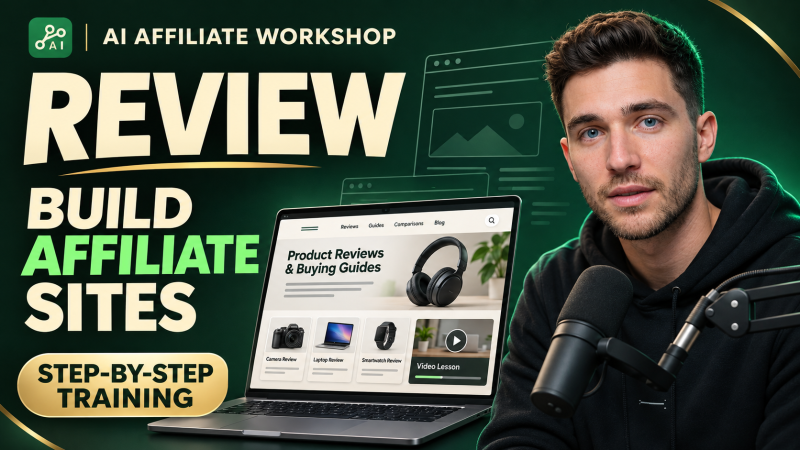
AI Affiliate Workshop is a video training course from Chris Derenberger that shows how he uses ChatGPT to research products, build interactive affiliate pages and complete review websites, and make affiliate videos, sold for a one-time price of $47 with no upsells.
Product Brand: Chris Derenberge
Product Currency: USD
Product Price: 47
Product In-Stock: InStock
4

