
ProductsPilot Review 2026
Can It Create Sellable Products?
Selling digital products looks simple until you try to build the whole machine yourself. Finding a niche is one job. Designing a product is another. Then you need mockups, printable sizes, listing copy, keywords, pricing, marketplace setup, and some way to get people to the listing.

That is where the workload usually becomes messy. You can use Canva for design, separate research tools for ideas, AI for copy, Etsy for selling, Pinterest for traffic, and a few spreadsheets to keep everything straight. None of those tasks is impossible. The problem is that they stack up fast.
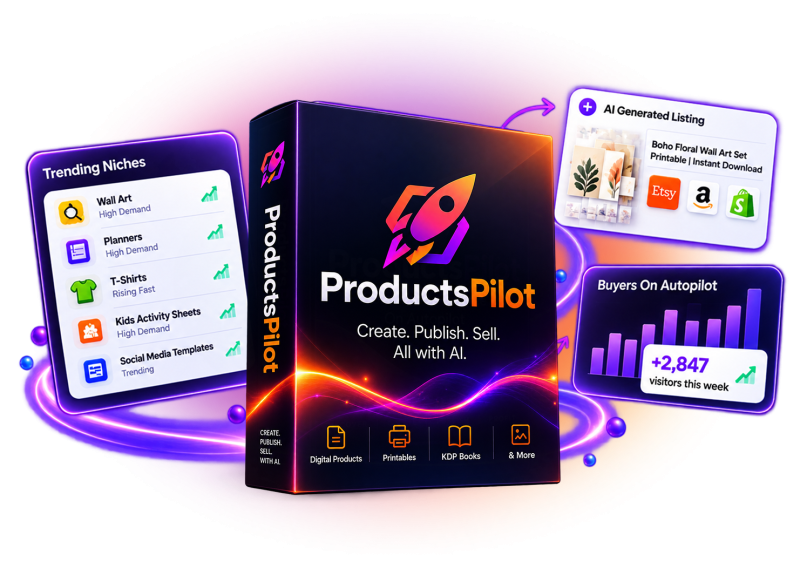
That is why ProductsPilot Review became interesting to me. ProductsPilot, created by Abhi Dwivedi, tries to connect research, product creation, listing preparation, and traffic generation inside one browser-based platform. The front-end offer focuses on eight digital product categories and allows up to 15 complete product sets per month.
What caught my attention is not simply that AI creates graphics. Plenty of tools can do that. ProductsPilot tries to handle the awkward work around the graphic: niche selection, coordinated sets, print formatting, mockups, marketplace copy, pricing guidance, and promotion.
Still, that raises the real question: does ProductsPilot actually reduce the work, or does it simply move the work into another dashboard?
After reviewing the demonstrated workflow, there are parts I like quite a bit, and there are also a few claims I would treat cautiously.
In this review, I will look at what ProductsPilot does, how its workflow works, what you actually receive for the front-end price, where manual work remains, the upgrade funnel, the ProductsPilot Bundle, its limitations, and who I think should seriously consider it.
Overview Of ProductsPilot
| Details | Information |
|---|---|
| Product | ProductsPilot |
| Creator | Abhi Dwivedi |
| Product Type | AI digital product creation and marketing platform |
| Launch Date | September 29, 2026 |
| Front-End Price | $37 |
| Payment Model | One-time launch offer according to the supplied product information |
| Product Limit | 15 complete products per month |
| Product Categories | 8 on the front end |
| Core Marketplace Packs | Etsy and Gumroad |
| Traffic System | Multi-channel Traffic Builder |
| Commercial Rights | Included |
| Guarantee | 14-day money-back guarantee |
| Platform | Cloud-based |
| Bundle Price | $317 |
| Bundle Coupon | Pilot – $50 off according to the supplied offer |
The front-end package includes niche research, seasonal intelligence, 15 finished products each month, eight product categories, AI style directions, print-ready files, mockups, Etsy and Gumroad listing packs, two shops, commercial rights, product history, exports, and the Traffic Builder.
What Is This App?
ProductsPilot is an AI-assisted system for researching, creating, packaging, listing, and promoting downloadable digital products.
The easiest way to understand it is through four connected jobs.
Agent 1 researches what to create.
It surfaces niche and product ideas, scores opportunities using demand and competition information, considers seasonality, and lets you validate your own idea before investing time in production.
Agent 2 creates the product.
Instead of producing one isolated AI image, it creates coordinated product sets. Depending on the category, those can include multiple designs or pages, common print sizes, US Letter and A4 formats, bleed and trim marks, hyperlinked digital-planner navigation, and buyer sizing instructions.
Agent 3 prepares the product for sale.
This side generates lifestyle mockups, marketplace listing copy, tags, categories, suggested price bands, trademark screening, and Etsy AI-disclosure information.
Agent 4 works on promotion.
Its Traffic Builder covers several promotional channels, including social micro-content, Q&A outreach, Pinterest, PDF guides, video syndication, guest-post/link-building outreach, and Google Web Stories.
That relationship is what separates ProductsPilot from a normal AI image generator.
- ProductsPilot → creates → digital product packages.
- ProductsPilot → prepares → marketplace listings.
- Traffic Builder → promotes → published products.
In other words, the platform is less about generating one attractive picture and more about assembling the workflow around selling digital downloads.
Who’s Behind The Creation?
ProductsPilot is associated with Abhi Dwivedi, founder of VineaSX Solutions.
The supplied product material references a long list of previous software releases, including ChannelBuilderAI, ContentClaw, LocalBizAI, ShopReelAI, AIFlipDomains, AIWhitelabels, and other AI or marketing applications.
That history gives buyers some background on who is behind the product.
However, I would not buy ProductsPilot simply because the creator has launched software before.
For me, the actual workflow matters more.
And that workflow is where ProductsPilot becomes interesting.
The Features Of ProductsPilot
ProductsPilot contains plenty of individual functions, but counting features does not tell you whether the software will actually make your work easier.
These are the parts I would pay attention to.
Research before creation
One of the easiest ways to waste time with digital products is to spend an afternoon designing something simply because you personally like the idea.
ProductsPilot tries to put research ahead of design.
Its niche system shows opportunities together with demand and competition indicators. Seasonal intelligence is also designed to surface products before their relevant season rather than after buyer interest has already peaked.
You can also bring your own idea into the system for evaluation.
I like the logic.
Even if no automated score can predict future sales perfectly, making the seller consider demand + competition + timing before creating a product is better than blindly opening a design tool.
A score is still a research signal.
It is not a sale.
Complete products instead of single AI images
This is one of ProductsPilot‘s more useful ideas.
The front end supports:
- Wall art
- Planners
- Digital planners
- Templates
- Invitations
- Kids and education products
- PDF reports and guides
- Craft files
You receive up to 15 complete products per month, rather than a limit of 15 individual images.
That difference matters.
A printable seller may need several sizes. A planner needs pages that belong together. An invitation needs correct print specifications. Digital planners may need working hyperlinks.
ProductsPilot tries to deal with those production details automatically.
That is more valuable to me than simply telling users the software has an AI image generator.
Making a picture is easy.
Preparing something a buyer can actually download and use is where the tedious work begins.
Style direction without requiring serious design skills
The workflow presents style directions for the chosen niche. Users can select one or reroll for alternatives.
There is also room to provide additional design direction.
For a beginner, that reduces blank-canvas paralysis.
For an experienced designer, it may feel restrictive.
If typography, exact layouts, detailed brand systems, or fine-grained editing are central to your workflow, a dedicated design application will still offer more control.
I see ProductsPilot as a production system first and a detailed design studio second.
Print-ready preparation
ProductsPilot says it creates products in appropriate print resolutions and formats, including US Letter and A4 where required.
The feature set also includes bleed and trim marks for suitable print products, working tab navigation in digital planners, and sizing guides included with delivered ZIP packages.
These features are not exciting in a demo.
They are useful in actual selling.
Customers notice when a file does not print correctly.
They notice when planner tabs do not work.
They notice when they cannot figure out what size they received.
Quiet production details often matter more than another flashy AI button.
Automatic lifestyle mockups
ProductsPilot also prepares lifestyle-style product mockups.
This helps transform a flat downloadable file into something people can visualize using.
However, I would inspect every mockup before publishing.
Look for incorrect cropping, distorted layouts, misleading scale, strange AI artifacts, or a presentation that makes the product look different from what the buyer actually receives.
AI can prepare the presentation.
You still own the listing.
Marketplace listing material
ProductsPilot creates information needed to prepare listings, including:
- Titles
- Descriptions
- Tags
- Categories
- Attributes
- Suggested pricing
- AI disclosure information
The front end specifically includes listing packs for Etsy and Gumroad.
This can remove a surprising amount of repetitive work.
But there is an important nuance.
The demonstrated Etsy workflow is not fully autonomous publishing.
ProductsPilot prepares the material, then the user copies the images, title, description, tags, category, AI disclosure, and pricing into Etsy before publishing the listing and putting the final URL back into ProductsPilot.
So I would describe this as guided listing preparation, not completely hands-off Etsy publishing.
I actually prefer knowing that.
It means you retain a final checkpoint before anything goes live.
Trademark screening
ProductsPilot includes trademark screening before publishing.
That is a useful safeguard for new sellers who may not realize that a popular phrase or name could create intellectual-property problems.
Still, screening is not the same as legal clearance.
If your product depends on a brand, character, celebrity, franchise, protected phrase, or another person’s intellectual property, I would investigate it independently before publishing.
The Traffic Builder
This is one of the platform’s biggest promises.
ProductsPilot describes multiple promotion methods tied to the collections you create:
- AI-generated social micro-content
- Q&A outreach
- Pinterest pins and boards
- PDF guide distribution
- Video syndication
- Link-building and guest-post outreach
- Google Web Stories
The demonstrated workflow shows generated Pinterest content, social material, scheduling, promotional images, headlines, descriptions, video options, and other traffic-related assets.
This is also where I would become more skeptical.
Generating promotional assets is verifiable as a software function.
Generating meaningful traffic is a business outcome.
Those are not the same thing.
Traffic depends on the quality of the content, competition, platform policies, the niche, account authority, timing, search visibility, and how real users respond.
I would therefore buy ProductsPilot primarily for its research, creation, packaging, and listing workflow.
I would treat the traffic tools as something to test rather than an automatic source of buyers.
How Does ProductsPilot Work?
The demonstrated workflow is fairly straightforward.
Step 1: Create a collection
Inside the dashboard, ProductsPilot refers to products as collections.
You begin by creating a new collection or product.
Step 2: Select a niche
The system presents niche and product opportunities alongside trend-style scores.
You can choose one of its recommendations or work with your own idea.
Step 3: Pick a style
ProductsPilot then presents visual directions.
You can choose one or provide more guidance.
This is where the simplified niche + look concept comes from.
Step 4: Set product-specific options
Depending on the product, ProductsPilot asks for the information it needs to construct the finished set.
For example, the demonstrated digital planner workflow lets the user choose the number of pages.
Step 5: Generate
The software processes the collection and prepares the files.
The product materials describe an approximate four-minute machine-generation process. I would treat that as a vendor-described or demo-specific time rather than assume every product will always finish in exactly four minutes.
Step 6: Inspect the product
This is where I would stop clicking and actually review things.
- Read the copy.
- Check dates.
- Open every page.
- Test planner links.
- Look at spelling.
- Inspect image quality.
- Verify sizes.
AI can make a mistake just as quickly as it can make a product.
The first completed generation should be treated as something to approve, not something to blindly publish.
Step 7: Review the mockups
Make sure they represent what customers will actually receive.
Step 8: Prepare the marketplace listing
For Etsy, the demonstrated process follows a sequence of copy-and-paste tasks.
ProductsPilot supplies the material.
You put it into Etsy.
Once the listing is live, you add the URL back into ProductsPilot for tracking and promotion.
Step 9: Use the traffic tools
You can then select a collection and generate promotional content for it.
That gives ProductsPilot a relatively clear workflow:
Research → Create → Review → Package → List → Promote.
That connected sequence is the real product.
For a thorough exploration of the platform, be sure to check out the demo video below:
Who Is The Audience For This?
ProductsPilot makes the most sense for people who want to sell digital downloads but dislike the fragmented workflow required to get them online.
Beginners entering digital-product selling
This is probably the clearest audience.
Instead of asking, What should I make?, the system gives you research signals and ideas to investigate.
Instead of asking, What size should this be?, ProductsPilot handles much of the packaging.
Instead of staring at an empty Etsy description field, you begin with prepared copy.
That removes several common starting points for procrastination.
Etsy and Gumroad sellers building a catalogue
Fifteen products each month gives sellers room to build consistently.
If the monthly allowance were fully used for twelve months, that would be up to 180 generated product sets.
That is production capacity, not a sales forecast.
A large catalogue filled with products nobody wants is still a bad catalogue.
People who dislike design work
ProductsPilot reduces the number of creative decisions required.
If you want to run a digital-product business rather than become a graphic designer, that can be useful.
Freelancers and agencies
Commercial rights are part of the supplied front-end offer. The workflow also supports downloadable packages that can be used in client work.
People who want heavier client management should pay more attention to the agency-oriented upgrades and bundle options.
Who may not need it?
I would be less interested if you are:
- A professional designer who wants detailed creative control.
- Already operating a mature multi-tool production system.
- Creating only a handful of highly customized products.
- Expecting AI to guarantee Etsy rankings.
- Expecting traffic automation to guarantee buyers.
- Unwilling to manually review AI-generated files.
- Planning very high production volume without upgrading.
ProductsPilot can reduce repetitive work.
It cannot remove commercial judgment.
Why Is It Worth Checking Out?
The main reason I would consider ProductsPilot has very little to do with the words artificial intelligence.
AI itself is no longer unusual.
The interesting part is workflow compression.
A seller normally has to move between research, design, image generation, formatting, mockups, listing copy, pricing, marketplace publishing, and traffic creation.
ProductsPilot tries to connect those jobs to one collection.
That means less context switching.
And context switching is where a lot of digital-product projects die.
Someone researches ten ideas, designs half of one, opens Etsy to investigate keywords, gets distracted by competitor listings, creates a Pinterest account, goes back to Canva, and somehow four hours have disappeared.
ProductsPilot tries to provide a path through that mess.
I also like the emphasis on complete product sets.
A marketplace customer does not care which AI model you used.
They care whether the download works.
- Does it print correctly?
- Are all the pages there?
- Do the hyperlinks function?
- Does the design shown in the mockup match the file?
- Can they understand how to use it?
Those questions matter more.
The biggest uncertainty remains the Traffic Builder.
I would not purchase ProductsPilot because someone says automated traffic will produce buyers.
I would purchase it because the creation side could save repetitive production work, then test the traffic functions separately.
That distinction keeps expectations sensible.
The Price
The supplied launch information lists the ProductsPilot front end at $37.
That includes:
The offer also states a 14-day money-back guarantee.
For a new buyer, the front end gives you enough of the core workflow to evaluate the product.
That is important.
You do not need to buy everything just to find out whether ProductsPilot fits your way of working.
My buying approach would be simple:
- Start with the smallest package that lets you test the real workflow.
- Generate products.
- Review them.
- Create a marketplace listing.
- Test the listing assets.
- Try the Traffic Builder.
- Then find out what limitation actually affects you.
Upgrade because you need something.
Not because an upgrade page exists.
The OTO Details
ProductsPilot also has optional upgrades aimed at capacity, owned storefronts, client work, and additional marketplaces.
OTO 1: ProductsPilot Unlimited – $67 >>More Details<<
Unlimited is mainly a production-capacity upgrade.
It adds:
- Unlimited monthly products
- Premium image engine
- Bulk creation of up to 20 products
- Priority processing
- Four concurrent jobs
- API access
- 14-day guarantee
This makes sense once you have already proven that the ProductsPilot workflow works for you.
If you are completely new?
Fifteen front-end products per month is enough to find out.
I would not upgrade just because unlimited sounds better.
OTO 2: ProductsPilot Diamond Storefront – $97 >>More Details<<
Diamond shifts the focus from marketplaces toward owning the sales environment.
The supplied package includes:
- Branded storefront
- Own-domain support
- Buyer capture
- AI-generated follow-up sequences
- Product bundle building
- Direct checkout
- Traffic Builder pointed toward the owned property
- Five prepared sequences
- Twelve lead magnets
- Setup assistance
- 14-day guarantee
This upgrade becomes more interesting if your goal is to build an email list and customer base rather than relying completely on Etsy or Gumroad.
The practical question is simple:
Do you just need products?
Or do you want to own more of the relationship with the buyer?
If the latter matters, Diamond has a clearer purpose.
OTO 3: ProductsPilot Platinum Agency – $97 >>More Details<<
This version targets people doing client work.
It includes:
- 25 separate client shops
- Client management records
- White-label branding
- Optional custom domain
- Scheduled branded PDF reports
- Team-member access
- 14-day guarantee
Someone building products only for their own business can probably skip this.
Someone selling product-creation or shop-management services has a much stronger reason to consider it.
OTO 4: ProductsPilot Elite Marketplace – $67/year >>More Details<<
Elite expands marketplace reach.
The supplied information lists eight additional destinations:
- Shopify
- Printify
- Amazon KDP
- Teachers Pay Teachers
- Creative Market
- Design Bundles
- Payhip
- Notion
It also adds marketplace-specific listing material, low-content books as a ninth product type, KDP-ready covers, API publishing for Shopify and Printify, and broader use of the Traffic Builder.
This upgrade makes the most sense when Etsy and Gumroad start feeling restrictive.
I would not buy broader marketplace support before I know I can produce something worth distributing.
First prove the product.
Then multiply the places you sell it.
The Bundle Offer
The ProductsPilot Bundle is listed at $317, and the supplied offer says the coupon code Pilot takes $50 off. If that coupon is still accepted at checkout, that reduces the bundle price to $267.
There is an important detail here that buyers should notice.
The bundle information provided for ProductsPilot does not simply say, Premium + Unlimited + Diamond + Platinum + Elite.
Instead, it describes the package as:
Everything in ProductsPilot Premium, plus three larger upgrades:
- Profit Engine
- Agency Unlimited
- Turbo Growth
That means I would not assume the $317 bundle and the normal OTO path are interchangeable. The names and included features are different in the supplied offer. Read the actual bundle checkout carefully before purchasing so you know exactly which licenses and modules are being delivered.
How Much Does The Bundle Really Cost?
The listed bundle price is:
ProductsPilot Bundle: $317
The supplied material also provides:
- Coupon Code: Pilot
- Discount: $50
So, if the coupon is active and applies successfully at checkout:
$317 – $50 = $267
That makes $267 the effective promotional bundle price described in the supplied offer.
I would still verify the final checkout total before paying.
Launch offers can change, coupons can expire, and the exact billing terms matter more than promotional graphics.
Bundle Vs Front End: Which Makes More Sense?
This is where I would avoid the usual affiliate answer of telling everybody to buy the biggest package.
The $37 front end makes more sense if:
- You are new to selling digital products.
- You mainly want to test Etsy or Gumroad.
- Fifteen products a month is enough.
- You do not manage clients.
- You do not need heavy traffic automation.
- You want to validate the output quality before spending more.
The bundle becomes more interesting if:
- You already know you want to build a larger operation.
- You plan to manage multiple audiences.
- You want agency/client capabilities.
- White-labeling matters.
- You want many separate client accounts.
- You expect to use monetization tools such as offer matching and link testing.
- Higher-frequency promotion fits your strategy.
- Reporting and team access matter to your business.
For me, Agency Unlimited is the biggest dividing line.
If I were buying ProductsPilot only to open my first Etsy shop, I would start smaller.
If I were planning to sell digital-product creation as a service to clients, the economics change. Fifty isolated client accounts, white-label capabilities, reports, client-acquisition material, and team access are features that could actually enter the business workflow.
Is The ProductsPilot Bundle Worth It?
The bundle is not automatically better simply because it contains more software.
Its value depends on what you intend to do with ProductsPilot.
For a beginner, $37 gives you a much cheaper way to answer the first question: can this platform create products I am comfortable selling?
I would answer that before spending $267 or $317.
- Build several products.
- Open the files.
- Check the design quality.
- Prepare a listing.
- Publish something.
- Run a small promotion.
- See whether the workflow fits you.
If it does, and you already know that you need client accounts, white-label features, monetization tools, heavier promotion, and analytics, then the bundle becomes much easier to justify.
If not, buying dozens of extra capabilities simply creates a larger dashboard.
More features do not automatically mean more progress.
My preferred buying logic remains the same: Start with the version that solves today’s problem. Upgrade when a real limitation appears.
Pros & Cons
Pros
- Connects research, creation, listing preparation, and promotion.
- Creates complete product sets rather than isolated AI images.
- Supports eight front-end product categories.
- Includes 15 complete products each month on the base offer.
- Handles several tedious print-formatting details.
- Generates lifestyle mockups.
- Provides Etsy and Gumroad listing material.
- Includes pricing suggestions.
- Includes trademark-screening functionality.
- Commercial rights are included in the supplied front-end offer.
- Traffic tools use the same product collections created inside the platform.
- Cloud-based workflow.
- Front end offers enough functionality to test before upgrading.
- Optional upgrades cover higher volume, owned storefronts, client work, and more marketplaces.
- The bundle adds larger monetization, agency, and promotion capabilities.
- Supplied bundle coupon reduces the stated $317 price by $50 if still active.
- 14-day guarantee is stated for the core offer and individual OTOs.
Cons
- Etsy listing publication still includes manual copy-and-paste steps.
- Fifteen monthly products may become restrictive for high-volume users.
- Broader marketplace reach requires an upgrade.
- AI-generated products still require human quality control.
- Promotional automation does not guarantee meaningful traffic.
- Traffic does not guarantee sales.
- Automated outreach needs careful review before publishing.
- Trademark screening should not be treated as legal advice.
- Experienced designers may want more creative control.
- The bundle’s upgrade structure differs from the separately listed OTO structure, so buyers should verify exactly what is included at checkout.
- Many bundle functions are unnecessary for someone running only one small shop.
- Vendor-assigned package values should not be confused with independently verified market value.
Is ProductsPilot Legit?
ProductsPilot has a defined software workflow, product information, creator attribution, pricing structure, front-end package, optional upgrades, and demonstration material.
The demonstrated workflow shows niche selection, product creation, marketplace preparation, storefront functions, and traffic-generation tools.
That supports the existence of the platform and its workflow.
It does not prove that every generated product will sell.
That distinction is essential.
A legitimate tool can produce a product nobody wants.
A niche with apparent demand can still be competitive.
A Pinterest pin can be published and receive little traffic.
A good listing can exist in a shop that never gains momentum.
So I would not judge legitimacy by income promises.
I would judge ProductsPilot by whether the software performs the jobs it demonstrates:
- Research.
- Creation.
- Packaging.
- Listing preparation.
- Promotion support.
Those are reasonable things to test during the refund period.
Final Verdict
ProductsPilot addresses a real problem.
Digital-product selling is rarely one job.
It is a chain of research, design, formatting, mockups, copywriting, marketplace setup, file preparation, and promotion.
ProductsPilot’s strongest idea is connecting those pieces.
The front end also appears substantial enough that a beginner does not need to immediately purchase the whole funnel just to test the concept.
That matters to me.
At $37, I would first use ProductsPilot to create several products, inspect them carefully, prepare a live listing, and test the promotion workflow.
Then I would decide what I actually need.
If the 15-product cap gets in the way, look at higher-capacity options.
If owning the storefront becomes important, consider the storefront upgrade.
If additional marketplaces become part of the plan, evaluate Elite.
If you are building a client-facing business and want white-labeling, dozens of client accounts, reporting, monetization tools, and heavier promotion, then the ProductsPilot Bundle becomes much more relevant.
The listed bundle price is $317, with the supplied Pilot coupon reducing that by $50 to $267 if the coupon remains valid at checkout.
But I would not buy the bundle merely because the combined vendor-stated value looks large.
Buy it because the extra modules solve problems you genuinely expect to have.
The biggest limitation of ProductsPilot remains unchanged: automation can shorten the journey from idea to listing, but it cannot decide what people will buy with certainty.
You still need judgment.
You still need quality control.
You still need to follow marketplace rules.
You still need to watch how the market responds.
That is why I see ProductsPilot as an AI-assisted digital-product production and marketing system, rather than an automatic income machine.
For someone who keeps getting stuck between I want to sell digital products and I actually have a finished product live for sale, that difference could make ProductsPilot worth considering.
Frequently Asked Questions
What is ProductsPilot?
ProductsPilot is a cloud-based AI-assisted platform for researching digital-product opportunities, creating finished product sets, preparing marketplace listings, and generating promotional assets.
How much does ProductsPilot cost?
The supplied launch information lists the front-end price at $37.
How many products can I create?
The front-end package provides 15 complete products per month.
What kinds of products can it create?
The front end covers wall art, planners, digital planners, templates, invitations, kids and education products, PDF reports and guides, and craft files.
Does ProductsPilot automatically publish Etsy listings?
The demonstrated Etsy workflow still asks the user to copy prepared images, copy, tags, category information, disclosure details, and pricing into Etsy before publishing.
Does ProductsPilot include commercial rights?
The supplied front-end information states that full commercial rights are included for the products users create.
What is the ProductsPilot Bundle price?
The supplied bundle information lists a price of $317.
Is there a ProductsPilot Bundle coupon?
Yes. The supplied offer lists coupon code Pilot for $50 off. If it remains active and applies successfully, that would reduce $317 to $267.
What is included in the ProductsPilot Bundle?
The bundle is described as including everything in Premium plus Profit Engine, Agency Unlimited, and Turbo Growth. These add monetization tools, offer matching, split testing, up to 50 isolated client accounts, white-label capabilities, reporting, client-acquisition assets, higher-frequency posting, analytics, and an AI coaching component.
Is the bundle the same as buying all four ProductsPilot OTOs?
The supplied information does not present it that way. The normal OTOs are listed separately as Unlimited, Diamond Storefront, Platinum Agency, and Elite Marketplace, while the bundle is described using Profit Engine, Agency Unlimited, and Turbo Growth. Buyers should therefore verify the exact bundle contents at checkout rather than assume the packages are identical.
Should beginners buy the bundle?
I would first test the $37 front-end workflow unless you already know you need client accounts, white-labeling, monetization tools, higher-volume promotion, and the other bundle-specific functionality.
Does ProductsPilot guarantee sales?
No conclusion like that is supported by the workflow itself. The software can assist with product creation, listing preparation, and promotion, but buyer demand and sales depend on many outside factors.
Does ProductsPilot have a refund policy?
The supplied product information states a 14-day money-back guarantee.
ProductsPilot is a cloud-based AI-assisted platform for researching digital-product opportunities, creating finished product sets, preparing marketplace listings, and generating promotional assets.
Product Brand:
Abhi Dwivedi et al
Product Currency:
USD
Product Price:
37
Product In-Stock:
InStock ProductsPilot
4.4
(You will receive ALL Bonuses on Part 1 to Part 5)
PART 1
PART 2
PART 3
PART 4
PART 5
And you can pick 1 package (for each purchase) from the following packages that you think are the most useful for you:
***3 STEPS TO CLAIM THIS BONUSES***
Step 1: Order ProductsPilot Review through my ProductsPilot Review:
Step 2: After you complete the order, send [the receipt id] in a message to my email at: support@tikareview.com or complete your information on this page.
Step 3: I will send all bonuses for you within 24 hours. Please wait your bonus.

