
AppsfieldAI Review
Can This AI Store Builder Sell Software for You?
Building an online store is only one part of selling digital products.
You still need products to list, persuasive sales copy, a checkout system, customer support, lead capture, follow-up emails, and enough traffic to bring potential buyers through the door. For beginners and small agencies, connecting all those pieces can become expensive and technically demanding.
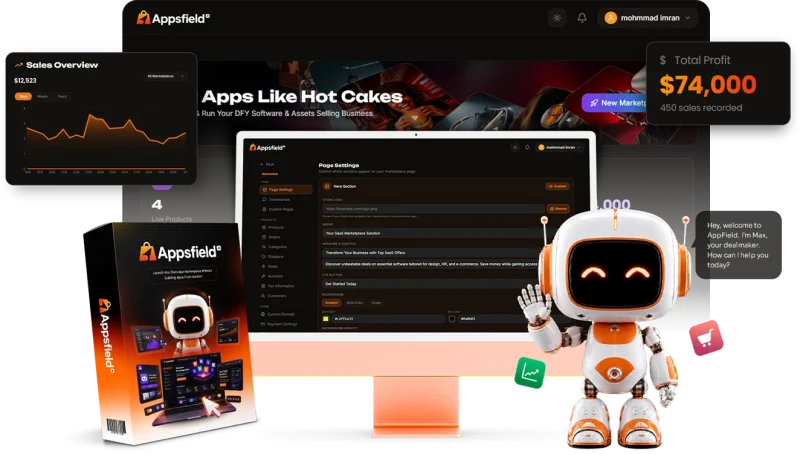
AppsfieldAI attempts to simplify that process by combining an AI-powered storefront builder with a conversational sales agent. The platform creates a branded digital marketplace, stocks it with ready-made AI applications, and places an AI DealMaker Agent inside the store to speak with visitors, recommend products, answer questions, collect leads, and guide buyers toward checkout.
The concept is more ambitious than a conventional store builder. Rather than giving you a page and leaving the selling entirely to you, AppsfieldAI is designed to create a storefront that actively interacts with visitors.
In this AppsfieldAI review, I will explain what the platform does, how the demonstrated workflow operates, who may benefit from it, the current pricing structure, its optional upgrades, and the important points buyers should check before purchasing.
Disclosure: This article may contain affiliate links. If you purchase through one of these links, TikaReview may earn a commission at no additional cost to you. This does not affect our editorial evaluation.
AppsfieldAI Review: Quick Verdict
AppsfieldAI may be worth considering for affiliate marketers, software resellers, freelancers, and small agencies that want to launch an AI software storefront without building the entire infrastructure manually.
Its strongest feature is the combination of storefront creation, conversational product recommendations, in-chat checkout, lead collection, custom project requests, and order management in one dashboard.
However, buyers should not assume that creating a store automatically produces sales. You will still need a relevant audience, suitable products, trustworthy positioning, and a traffic strategy. Some advanced functions—including custom domains, unlimited usage, client prospecting, marketing automation, and multi-vendor features—are placed in optional upgrades.
Best for: Affiliate marketers, digital product sellers, freelancers, consultants, and small agencies.
Main strength: It combines store creation with an AI sales conversation and checkout workflow.
Main limitation: The complete feature set is divided across several paid upgrades.
Overall recommendation: A promising option for users who want a guided way to launch and operate an AI product marketplace, provided they understand the funnel structure and are prepared to market the store.
AppsfieldAI Overview

| Product | AppsfieldAI |
| Creators | Pankaj Malav and Deepanker Rajora |
| Product Type | AI storefront and digital marketplace builder |
| Launch Date | July 31, 2026 |
| Front-End Price | $37 one-time
Coupon: EARLY10 for 10% off |
| Official Website | https://appsfieldai.com |
| Bundle Price | $317 one-time
Bundle Coupon: EARLY50 for $50 off |
| Official Bundle Website | https://appsfieldai.com/bundle |
| Refund Period | 30-day money-back guarantee |
| Delivery | Cloud-based platform |
| Core Use Case | Creating and operating AI software stores |
| Support | https://appsfieldai.tawk.help/ |
Prices and offer terms can change after the launch period, so buyers should verify the checkout page before purchasing.
What Is AppsfieldAI?
AppsfieldAI is a cloud-based platform designed to create an online marketplace for selling AI applications, digital products, and—in an optional upgrade—services.
The front-end offer is presented as a fast store-building system. A user names the marketplace, describes the type of products they want to sell, selects a theme and product categories, adds branding, and launches the store through a guided setup process.
The platform then generates core storefront elements, including:
- Store branding and page structure
- Hero copy
- Product categories
- Frequently asked questions
- Product listings
- Promotional page sections
- A conversational AI sales agent
The official positioning says the store can be created in approximately 60 seconds. That should be understood as a developer claim rather than a guaranteed setup time for every user. Actual completion time may depend on branding decisions, product configuration, internet speed, and any manual changes required.
What separates AppsfieldAI from a standard ecommerce builder is its DealMaker Agent. This agent appears inside the storefront as a conversational assistant. It asks visitors about their needs, suggests appropriate products, explains features, handles product-related questions, captures contact information, and opens the checkout form directly inside the conversation.
Who Created AppsfieldAI?
Pankaj Malav and Deepanker Rajora created AppsfieldAI.
They have previously been associated with AI, video, content creation, automation, and online marketing products, including ClipsField AI, SuperclipsAI, and HookedAI.
That background is relevant because AppsfieldAI combines several of the same areas: AI-generated content, product presentation, automated customer interaction, video-based demonstrations, and digital marketing.
A creator’s launch history does not guarantee the performance of a new product, but previous involvement in related software categories can be a useful signal when evaluating whether a team understands the intended market.
What Problem Does AppsfieldAI Try to Solve?
Many people want to sell software or digital services but struggle with the infrastructure required to turn an idea into a functioning business.
A conventional setup may require:
- A website builder
- Hosting
- Product pages
- Checkout software
- Payment processing
- A chatbot
- Email marketing
- Lead management
- Customer delivery
- Analytics
- Traffic and prospecting tools
Even when each tool works well, connecting them can become confusing.
AppsfieldAI attempts to place the most important parts of that workflow inside one environment. It creates the store, places products inside it, engages visitors through an AI agent, captures sales or project requests, and provides tools for managing orders.
The practical value is not simply having more features. It is reducing the distance between a visitor discovering the store and taking a buying action.
How AppsfieldAI Works?
The demonstrated workflow follows a guided sequence.
Step 1: Open the Main Dashboard
After logging in, users reach a dashboard that displays a high-level view of their business.
The dashboard includes information such as:
- Active products
- Total orders
- Customer numbers
- Revenue
- Sales analytics
- Existing stores
This gives store owners a central place to monitor activity rather than checking several disconnected systems.
Step 2: Create a New Marketplace
To begin, the user clicks New Marketplace.
The setup asks the user to select a marketplace type. The demonstrated example uses a single-vendor marketplace.
The user then enters a store name. AppsfieldAI automatically creates a URL slug based on that name.
Step 3: Describe the Store
The marketplace agent asks for a simple description of what the store will sell.
In the demonstration, the prompt describes a store selling AI software for local businesses such as gyms, cafés, and real estate companies.
This prompt matters because it guides the platform when generating the store structure, product categories, page copy, and initial product selection.
A clear, specific description is likely to produce a more focused store than a broad instruction such as “sell AI tools.”
Step 4: Choose the Theme and Visual Style
Users select a color preset and a storefront template.
The demonstrated theme options include:
- Standard
- Minimal
- Bold
- Enterprise
- Aurora
- Batasso
- Neon Grid
- Nitro
Some premium themes are included in the Pro upgrade.
The theme stage helps users create a more suitable visual identity without designing the store from scratch.
Step 5: Add Branding
Users can customize their primary and accent colors.
They can also upload a logo and favicon from the media library.
This is important for freelancers and agencies because a generic storefront may look temporary. Consistent branding can make the store appear more credible and better aligned with the intended niche.
Custom-domain support is listed under the Pro upgrade rather than the basic front-end package.
Step 6: Select Product Categories
AppsfieldAI suggests categories such as CRM, AI and machine learning, and design.
Users can also add custom categories.
This allows the store to organize products around the audience’s actual needs instead of placing every product in one general catalog.
Step 7: Review and Launch the Store
Before publishing, users review:
- Marketplace type
- Store name
- Theme
- Visual style
- Branding
- Product categories
They then click Launch Marketplace.
The platform generates the storefront, applies branding, creates page content, adds frequently asked questions, preloads relevant products, and configures the AI sales agent.
Step 8: Test the Storefront
Once the marketplace is launched, it appears under My Stores.
Users can open the live storefront and inspect the generated page.
The demonstrated store includes:
- Hero banners
- Featured offers
- Category filters
- Reviews or testimonial-style content
- Value propositions
- FAQ accordions
- Product listings
- The AI sales assistant
Store owners should review all generated content before sending traffic to the page. AI-generated testimonials, claims, pricing, and product descriptions require particular care because inaccurate or unverified statements can damage trust.
Step 9: Let the DealMaker Agent Speak With Visitors
The AI sales agent opens a conversation with the visitor.
In the demonstration, the agent asks for the visitor’s name and business type. When the visitor says they operate in real estate, the agent recommends a relevant real estate AI assistant and displays a product card inside the conversation.
The visitor can ask for more information, review the product’s features, and continue toward checkout.
This is one of AppsfieldAI’s most useful capabilities. Instead of making visitors search through a large product catalog, the agent attempts to match them with an appropriate solution.
Step 10: Complete Checkout Inside the Conversation
When the visitor chooses to buy, AppsfieldAI opens the checkout form directly inside the chat window.
The demonstrated payment options include card payment and manual bank transfer.
Keeping the checkout inside the conversation reduces the number of page changes required before completing an order. A shorter buying path can be helpful, although actual conversion performance will still depend on trust, price, product quality, and the relevance of the offer.
Step 11: Capture Custom Project Requests
AppsfieldAI can also handle a situation where the visitor needs something that is not already listed.
In the demonstration, a visitor asks for AI automation software for a school. The agent asks follow-up questions about the school’s needs and uses the answers to prepare a custom scope for a School Performance Management System.
The visitor then enters their contact information and submits the project request to the store owner.
This extends AppsfieldAI beyond fixed-product sales. Freelancers and software agencies could use the same process to collect qualified project inquiries.
The agent does not complete the custom work itself. It gathers requirements and creates a structured request that the merchant can evaluate.
Step 12: Manage and Deliver Orders
Inside the order dashboard, the merchant can review purchases and update:
- Payment status
- Order status
- Delivery status
- Software login URL
- License key
Once an order is marked as delivered, the customer receives an email and can access their purchase through a client portal.
This creates a more organized delivery process than manually sending access details through individual emails.
Step 13: Manage Project Statuses
Custom requests appear under the project request area.
Merchants can review the client’s requirements and update the project through stages such as:
- Submitted
- Started
- In progress
- Completed
This can help agencies communicate progress more consistently, although the available information does not confirm whether advanced project-management features such as task assignment, deadlines, files, or team collaboration are included.
For a detailed guide on using the platform, watch the insightful demo video below:
EARLY10 — 10% OFF THE FRONT END
1. AI Marketplace Builder
AppsfieldAI uses a guided setup to generate a complete digital storefront.
The user chooses a niche, branding, visual style, and categories. The platform handles much of the initial page setup.
This may be useful for beginners who want to avoid designing every page section manually.
The generated store should still be reviewed and edited. Automation can accelerate the first draft, but it should not replace checking product accuracy, pricing, legal pages, and customer-facing claims.
2. Ten Preloaded AI Applications
The front-end offer is described as including ten ready-to-sell AI applications.
This gives new users initial inventory instead of requiring them to create every product before launching.
Buyers should verify the commercial-use terms attached to these applications, including:
- Whether they can change the product names
- Whether they can set their own prices
- Whether end users receive hosted access
- Whether usage limits apply
- Whether resale rights continue after future updates
The general product positioning says users sell through their own payment account and keep the revenue from their sales, but the exact licensing terms should be reviewed before building a business around the included applications.
3. DealMaker AI Sales Agent
The DealMaker Agent is the main differentiating feature.
It can:
- Greet store visitors
- Ask discovery questions
- Identify the visitor’s niche
- Recommend relevant products
- Explain product features
- Display product cards
- Present buying options
- Collect visitor details
- Open checkout
- Gather custom project requirements
This makes the store more interactive than a conventional catalog.
Its effectiveness will depend on the accuracy of its training, the quality of the product descriptions, and how well its answers match the merchant’s actual offers.
4. In-Chat Checkout
The embedded checkout lets visitors begin purchasing without leaving the conversation.
This can make the buying process feel more natural, especially when the visitor has already explained what they need.
The demo mentions manual bank transfer and card options. PayPal configuration is also shown in the store settings.
The available information does not clearly document every supported card processor, currency, tax setting, or regional limitation. International sellers should confirm those details before purchase.
5. Lead Capture and Conversation Records
AppsfieldAI logs customer conversations and captures contact details.
Leads may be categorized as buyers or prospects, helping merchants distinguish completed orders from people who showed interest but did not purchase.
This information can be valuable for follow-up campaigns, service proposals, and identifying common customer questions.
Users handling personal information should review the platform’s privacy, consent, storage, and deletion controls before collecting leads from regulated markets.
6. Custom Project Scope Generation
The AI agent can ask visitors about needs that are not covered by existing products and generate a structured project scope.
This could help:
- Software agencies
- Automation consultants
- Freelancers
- Local marketing providers
- Business process consultants
Instead of receiving a vague message such as “I need an AI system,” the merchant receives a more organized request that describes the intended functionality.
The generated scope should be treated as an initial requirements summary, not a final technical specification or binding proposal.
7. Order and Client Portal Management
AppsfieldAI provides an order area where merchants can update payment and delivery information.
Customers receive access through a personal portal where they can review receipts and retrieve software links.
This makes the platform more practical for digital product delivery than a simple landing-page builder.
8. AI Agent Training
Store owners can add custom business information to train the agent.
This allows the assistant to answer questions about:
- Products
- Policies
- Services
- Store details
- Delivery
- Business-specific information
Good training content is essential. A sales agent with incomplete information may give vague or inaccurate answers.
Store owners should test common questions before publishing and monitor conversations regularly.
9. Store Content and Branding Controls
Users can edit page content, branding, colors, logos, and visual themes.
They can also add tracking scripts such as Facebook Pixel and Google-related tracking code.
This is helpful for merchants who want to measure traffic and advertising activity.
Users should confirm that tracking and cookie consent are configured in line with the privacy laws that apply to their visitors.
10. AI Blog Creator
AppsfieldAI includes an AI blog creation feature that is presented as being able to discover niche keywords, generate SEO-focused articles, and publish them to the store.
This could help store owners create supporting content around the products they sell.
However, AI-generated articles should not be published without editing. Keyword selection, factual accuracy, originality, and search intent still need human review. Publishing large amounts of lightly edited content is unlikely to create sustainable organic visibility.
Usage limits for SEO blog posts appear to apply unless the Unlimited upgrade is purchased.
11. Lead Finder and Outreach
The demonstration includes a Lead Finder that searches for businesses by industry or city.
The AI can then prepare personalized outreach messages and send them to prospects.
A more extensive ClientFinder feature is listed under the Pro upgrade, so buyers should confirm exactly which prospecting functions are included in the front-end package.
Outreach users must also comply with email marketing, privacy, and anti-spam requirements in the regions they target.
But there’s still more – get AppsfieldAI and enjoy these exclusive bonuses:
EARLY10 — 10% OFF THE FRONT END
Who Is AppsfieldAI For?
Affiliate Marketers
Affiliate marketers could use AppsfieldAI to place several software offers inside a niche-focused store.
The sales agent may help visitors choose between products instead of forcing them to compare everything alone.
However, affiliates must ensure that the products are licensed for the intended method of promotion and that affiliate disclosures are clearly displayed.
Digital Product Sellers
People who already own software, ebooks, templates, or PLR products may use the marketplace as a central sales hub.
The Digital Products & Services upgrade expands this use case by allowing users to add more of their own products and sell services.
Freelancers and Consultants
Freelancers can use the custom project request workflow to gather better information from potential clients.
For example, an automation consultant could ask the agent to identify whether a visitor needs lead generation, appointment scheduling, customer support, or internal workflow automation.
Small Agencies
Agencies may find value in the combination of storefront creation, prospecting, custom proposals, customer portals, and order delivery.
The Franchise upgrade adds client stores, sub-accounts, multi-vendor functionality, and service-business assets.
Local Marketing Providers
The platform may suit marketers who want to sell AI solutions to gyms, cafés, real estate companies, schools, clinics, or other local businesses.
A focused store for one industry will generally be easier to position than a generic marketplace selling unrelated applications.
Beginners
The guided marketplace wizard appears approachable for users who do not have coding or advanced design experience.
Beginners should still expect to learn:
- Product positioning
- Store branding
- Traffic generation
- Lead follow-up
- Basic payment setup
- Customer support
- AI output review
The software simplifies implementation, but it does not remove the need to understand the business being built.
Who May Not Need AppsfieldAI?
AppsfieldAI may be less suitable for:
- Established ecommerce companies that already use a mature store and CRM system
- Developers who need extensive API access and custom backend control
- Sellers who only have one product and do not need a marketplace
- Users who expect the software to generate traffic and sales without promotion
- Enterprises requiring detailed compliance, security, procurement, and service-level documentation
- Agencies that need advanced project management rather than lead and order tracking
- Businesses that do not want to manage an upgrade-based product funnel
Those users may prefer a specialist ecommerce platform, CRM, chatbot system, or custom-developed sales environment.
AppsfieldAI Pricing
The AppsfieldAI front-end is listed at $37 as a one-time payment.
The coupon code EARLY10 is presented as providing 10% off the front-end purchase.
The offer also includes a stated 30-day money-back guarantee.
Buyers should verify the current price and refund terms at checkout because launch offers can change.
AppsfieldAI OTOs and Upgrades
The sales funnel includes five optional upgrades.
OTO 1: AppsfieldAI Pro — $67 One-Time >>More Details<<
AppsfieldAI Pro adds several branding, prospecting, communication, and import features.
It includes:
- ClientFinder
- Telegram integration
- Custom domains
- Automated SSL
- Custom SMTP
- Five premium themes
- Premium agent voices
- Character chat layouts
- Bulk product import through CSV and links
- Priority support
This upgrade is most relevant for users who want to present the store under their own domain and brand or conduct more active client prospecting.
OTO 2: AppsfieldAI Unlimited — $47 One-Time >>More Details<<
The Unlimited upgrade removes stated usage caps for:
- Stores
- Products per store
- DealMaker Agent conversations
- Stored leads
- SEO blog posts
- Coupons
- Group deals
- Auctions
This may be valuable for users running multiple stores or sending substantial traffic.
Occasional users may not need unlimited capacity immediately. It would be sensible to understand the front-end limits before deciding.
OTO 3: AppsfieldAI Digital Products & Services — $67 One-Time >>More Details<<
This upgrade expands AppsfieldAI beyond the preloaded AI software catalog.
It includes:
- Ten done-for-you information products
- Space for up to 50 user-owned products
- Support for selling PLR and ebooks
- Services Store Mode
- AI-assisted selling for services
- The ability to price and sell the user’s own inventory
This is likely the most relevant upgrade for product creators, PLR owners, freelancers, and service providers.
OTO 4: AppsfieldAI Marketing Department — $47 One-Time >>More Details<<
The Marketing Department upgrade focuses on traffic content and follow-up.
It includes:
- Automated blog publishing
- AI-generated product marketing images
- AI-generated promotional videos
- Email campaigns for captured leads
This could save time for users who need a basic content engine around their store.
The marketing output still requires review. Generated images, videos, blog posts, and email campaigns should be checked for accuracy, brand alignment, compliance, and quality before publication.
OTO 5: AppsfieldAI Franchise — $47 One-Time >>More Details<<
The Franchise upgrade turns AppsfieldAI into a multi-vendor and client-service platform.
It includes:
- Multi-vendor marketplace mode
- Vendor applications and approvals
- Configurable vendor commissions
- Automated vendor payouts with refund holds
- A built-in affiliate program
- Unlimited client stores
- Client sub-account logins
- Theme deployment across client stores
- Done-for-you proposals, contracts, and pricing guidance
This upgrade appears aimed at agencies and marketplace operators rather than individual sellers.
Before relying on automated commissions or payouts, users should confirm payment processor compatibility, accounting responsibilities, tax handling, refund procedures, and any legal obligations connected with operating a multi-vendor marketplace.
AppsfieldAI Bundle
The complete bundle is listed at $317 one-time.
The coupon code EARLY50 is presented as reducing the bundle price by $50, bringing the stated purchase cost to $267.
The bundle combines:
- The AppsfieldAI front end
- AppsfieldAI Pro
- AppsfieldAI Unlimited
- Digital Products & Services
- Marketing Department
- Franchise
- Associated bonuses and training
The bundle may make sense for an agency or serious marketplace operator that expects to use most of the upgrades.
A solo beginner should compare the bundle against the actual features they need. Buying every component is not automatically better if only the front-end store and one upgrade fit the intended business model.
EARLY50 — $50 OFF THE BUNDLE
NOTE:
Here are some OTO links for your reference. You have to buy FE firstly and then you can buy any OTOs if you like.
If you buy OTOs alone, you will receive NOTHING and it takes your time to ask for refund. Remember FE is a must-have package to at least make sure the software is working.
AppsfieldAI Pros and Cons
Pros:
+ Guided marketplace creation — The step-by-step wizard reduces the amount of technical setup required to launch a digital storefront.
+ Conversational product discovery — The DealMaker Agent can ask about a visitor’s business and recommend a relevant product rather than relying on passive browsing.
+ In-chat checkout — Visitors can move from the sales conversation to checkout without navigating through several pages.
+ Custom request capture — The agent can gather requirements for products or services that are not already listed.
+ Order delivery tools — Merchants can manage payment status, add access links or license keys, and deliver purchases through a customer portal.
+ Brand customization — Users can adjust colors, logos, themes, copy, categories, and page content.
+ Multiple potential business models — The platform can support software sales, affiliate promotion, digital products, services, client stores, and multi-vendor marketplaces, depending on the selected upgrades.
+ One-time launch pricing — The front end and listed upgrades use one-time pricing rather than recurring subscriptions.
+ Lead and conversation records — Store interactions can be logged, helping merchants follow up with buyers and prospects.
Cons:
– Important features are divided across upgrades — Custom domains, SMTP, unlimited usage, digital product expansion, marketing automation, and franchise features require separate purchases.
– Traffic remains the user’s responsibility — A functional store does not automatically bring qualified visitors or produce sales.
– AI output requires review — Store copy, blog posts, product explanations, project scopes, testimonials, and agent responses should be checked before use.
– Some technical details remain unclear — The available information does not fully document all payment processors, currencies, tax settings, privacy controls, API access, data export options, or regional restrictions.
– Product licensing needs careful review — Users should confirm exactly how the preloaded applications may be branded, priced, resold, delivered, and supported.
– New-platform risk — As a newly launched product, its long-term reliability, update frequency, support quality, and scalability have not yet been established through extended public use.
Important Points to Verify Before Buying
Before purchasing AppsfieldAI, I recommend confirming the following:
Front-End Limits
Check the exact limits on:
- Number of stores
- Products
- AI conversations
- Leads
- Blog posts
- Custom requests
- Orders
- Email sending
This will help you decide whether the Unlimited upgrade is necessary.
Commercial and Resale Rights
Confirm the license for the ten included AI applications.
In particular, verify whether you can:
- Sell them to unlimited customers
- Change their names and branding
- Set your own prices
- Offer them through client stores
- Continue selling them after the launch period
- Provide access without separate usage fees
Payment Processing
Confirm which payment gateways are supported and whether any fees or external accounts are required.
Also check:
- Supported countries
- Supported currencies
- Refund processing
- Tax settings
- Subscription payments
- Payout timing
Data and Privacy Controls
Because the platform stores conversations, names, emails, project details, and purchases, users should check:
- Data storage location
- Consent tools
- Privacy-policy settings
- Data deletion
- Export options
- User access controls
- Compliance documentation
Support and Updates
Verify the support desk, typical response channel, onboarding resources, product roadmap, and whether updates are included with the one-time purchase.
Refund Terms
The offer states a 30-day money-back guarantee, but buyers should read the exact refund policy at checkout, including any exclusions or conditions.
Is AppsfieldAI Legit?
AppsfieldAI is presented with a clearly demonstrated workflow, named creators, specific pricing, a working store-building process, a conversational checkout sequence, order management, and several defined upgrades.
Those factors make it appear to be a genuine software offer rather than a product described only through vague claims.
However, “legit” does not mean guaranteed to produce revenue.
The platform provides infrastructure that may help users create, present, and sell digital products. Business results will depend on factors such as:
- Product-market fit
- Traffic quality
- Offer pricing
- Trust
- Product quality
- Customer support
- Follow-up
- Compliance
- Consistent testing
AppsfieldAI should therefore be evaluated as a business tool, not as an automatic income system.
Is AppsfieldAI Worth It?
At the stated $37 front-end price, AppsfieldAI appears to offer a substantial amount of functionality for users who want to experiment with an AI-assisted software storefront.
The DealMaker Agent, in-chat recommendations, checkout workflow, custom project capture, order dashboard, and customer portal create a more complete sales process than a basic page builder.
The value becomes less straightforward when the upgrade funnel is considered. Users who need custom domains, unlimited capacity, services, marketing automation, or client marketplaces may spend considerably more than the front-end price.
AppsfieldAI is most likely to provide value when you already know:
- What niche you want to target
- Which products you will sell
- How you will reach potential customers
- How you will support buyers
- Which upgrades are necessary
It is less likely to help someone who buys the software without a niche, offer, audience, or promotional plan.
Final Verdict
AppsfieldAI brings together several useful ideas: fast marketplace creation, ready-made AI product inventory, conversational product recommendations, lead capture, embedded checkout, custom project requests, order delivery, and customer portals.
Its strongest advantage is the DealMaker Agent. The agent does more than answer basic questions. It attempts to identify visitor needs, recommend suitable products, present buying options, and turn requests for unavailable software into potential custom projects.
That makes AppsfieldAI particularly interesting for affiliate marketers, software resellers, freelancers, automation consultants, and small agencies.
The platform is not a replacement for traffic, sales strategy, product quality, or customer support. Buyers should also review the limits and licensing carefully, since several commercially important functions are available only through upgrades.
Overall, AppsfieldAI appears to offer a practical entry point for users who want to launch an AI product marketplace without building every component from scratch. For someone with a clear niche and a realistic promotion plan, it may be a useful platform to consider.
Frequently Asked Questions
What is AppsfieldAI?
AppsfieldAI is an AI-powered marketplace builder that creates digital storefronts, adds products, and places a conversational sales agent inside the store to assist visitors and guide them toward checkout.
How much does AppsfieldAI cost?
The front-end offer is listed at $37 as a one-time payment. The EARLY10 coupon is presented as providing 10% off. Pricing may change after the launch period.
Is AppsfieldAI a monthly subscription?
The current front-end and listed upgrades are presented as one-time purchases. Buyers should confirm whether any external services, payment processors, email providers, domains, or usage-based tools create additional costs.
Does AppsfieldAI include products to sell?
The front-end is described as including ten ready-to-sell AI applications. Buyers should review the exact licensing and delivery terms before reselling them.
Can AppsfieldAI sell my own products?
Support for a larger catalog of user-owned digital products and services is listed under the Digital Products & Services upgrade.
Can I use my own domain?
Custom-domain support is included in the AppsfieldAI Pro upgrade.
Does AppsfieldAI process payments?
The demonstrated workflow includes card payments, manual bank transfer, and PayPal configuration. The exact payment gateways and regional support should be confirmed before purchase.
Can AppsfieldAI find clients?
The demonstration shows a Lead Finder for searching businesses by industry or location. The Pro upgrade also lists a more extensive ClientFinder function.
Does AppsfieldAI generate traffic?
The platform includes blogging, prospecting, and optional marketing features, but it cannot guarantee traffic. Users still need to choose suitable audiences, create credible offers, and promote the store.
Is AppsfieldAI beginner-friendly?
The store-building wizard appears designed for beginners, although users still need basic knowledge of branding, products, payments, lead generation, and customer support.
Is there a money-back guarantee?
The product is presented with a 30-day money-back guarantee. Buyers should read the current refund terms before completing the purchase.
AppsfieldAI is an AI-powered marketplace builder that creates digital storefronts, adds products, and places a conversational sales agent inside the store to assist visitors and guide them toward checkout.
Product Brand:
Pankaj Malav and Deepanker Rajora
Product Currency:
USD
Product Price:
37
Product In-Stock:
InStock AppsfieldAI
4.5
(You will receive ALL Bonuses on Part 1 to Part 5)
PART 1
PART 2
PART 3
PART 4
PART 5
And you can pick 1 package (for each purchase) from the following packages that you think are the most useful for you:
***3 STEPS TO CLAIM THIS BONUSES***
Step 1: Order AppsfieldAI Review through my AppsfieldAI Review:
Step 2: After you complete the order, send [the receipt id] in a message to my email at: support@tikareview.com or complete your information on this page.
Step 3: I will send all bonuses for you within 24 hours. Please wait your bonus.

