
TokSnipe AI Review
Build A Smarter TikTok Shop Workflow From Product Research To Storefront Preparation
TikTok Shop can look simple from the buyer’s side: someone watches a short video, taps a product, and completes a purchase. For the seller, however, there is much more happening behind the scenes.
You need to decide which products are worth pursuing, understand whether a trend is already overcrowded, estimate the economics, find suitable creators, prepare promotional content, build accurate listings, identify suppliers, set pricing, and keep publishing content after the shop goes live.
Doing those jobs manually often means jumping between TikTok Shop, spreadsheets, creator profiles, AI writing tools, supplier marketplaces, and planning documents.
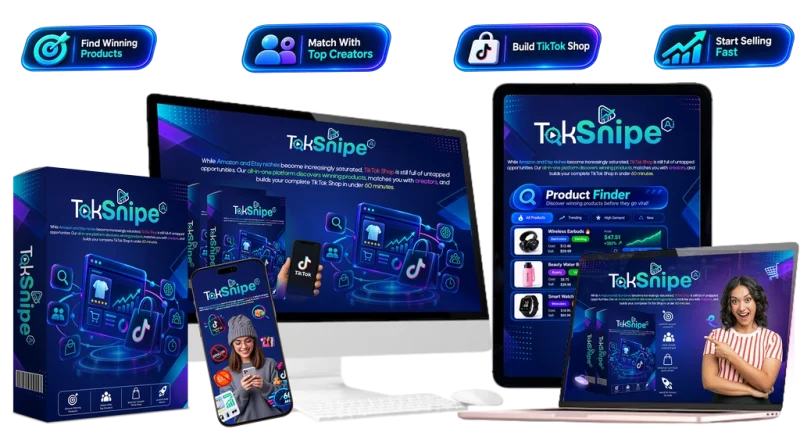
TokSnipe AI is designed to bring much of that workflow into one dashboard. Created by Daniel Adetunji and launched on August 25, 2026, it focuses specifically on helping users research TikTok Shop opportunities, evaluate competition, match products with creators, generate promotional assets, prepare storefront information, and organize ongoing promotion.
What makes the platform interesting is that it does not stop at presenting a list of trending products. The workflow continues from research into creator outreach, content preparation, storefront building, traffic planning, and portfolio management.
That does not mean TokSnipe AI runs an ecommerce business automatically. You still need to verify products, suppliers, margins, policies, creators, and TikTok Shop requirements yourself. But for sellers who want a more structured way to move from “What should I sell?” to “How do I prepare this opportunity for launch?”, the platform covers a useful amount of ground.
Affiliate disclosure: This review may contain affiliate links. If you purchase through one of them, Tika Review may receive a commission at no additional cost to you. Our conclusions remain based on the product’s documented capabilities and practical fit.
Overview Of TokSnipe AI

| Details | Information |
|---|---|
| Product | TokSnipe AI |
| Creator | Daniel Adetunji |
| Product Type | TikTok Shop research, automation, and business-building platform |
| Launch Date | August 25, 2026 |
| Front-End Price | Listed at $14 one-time in the current product information |
| Refund Policy | 30-day money-back guarantee |
| Main Use | Product research, competition analysis, creator matching, content generation, storefront preparation, and traffic planning |
| Official Website | Bluecodeapps TokSnipe AI |
| Best For | TikTok Shop sellers, ecommerce marketers, affiliate-focused sellers, and users building creator-led product campaigns |
| TikTok Shop Account Required | Yes |
One pricing note deserves attention before purchasing. The current product information lists the front-end at $14. Discount-code references also vary between sections. Because launch pricing and coupon availability can change, I recommend confirming the final price and working coupon directly on the checkout page rather than relying on an article snapshot.
What Is TokSnipe AI?
TokSnipe AI is a TikTok Shop-focused software platform that connects several stages of ecommerce opportunity development inside one workspace.
Instead of treating product discovery, creator outreach, content planning, and storefront preparation as completely separate jobs, TokSnipe links them together.
You can begin inside Product Radar, examine products showing active market signals, narrow the list by factors such as sales activity and saturation, and then inspect an individual opportunity in more detail.
From there, the same product can move into other parts of the platform.
You can examine its saturation score, compare commission potential, look for relevant TikTok creators, prepare personalized outreach, generate hooks and short-form video scripts, and use the Shop Builder Wizard to assemble the information needed for a TikTok Shop listing.
The important distinction is that TokSnipe is an assistant and workflow platform, not a replacement for TikTok Shop itself.
You still need an eligible TikTok Shop seller account and must satisfy the applicable requirements in your market. TikTok Shop is not universally available, so prospective users should confirm regional seller eligibility before buying the software.
The platform is therefore best viewed as a centralized research and preparation layer around TikTok Shop rather than an independent ecommerce marketplace.
Who Came Up With This Idea?
TokSnipe AI was created by Daniel Adetunji, a digital software developer whose previous products have covered areas such as social traffic, AI-assisted marketing, lead generation, content creation, and business automation.
Previous releases associated with him include TraffikGram, RedditRank AI, NoFace AI and ClickVideo 2.0.
That background makes the direction of TokSnipe understandable. The product combines several areas he has worked around before—social traffic, opportunity research, audience matching, AI-generated marketing material, and workflow automation—and applies them specifically to TikTok commerce.
For buyers, the more important consideration is not simply the creator’s previous launch history but whether the actual TokSnipe workflow solves a meaningful problem. In this case, the strongest argument is the connection between its research tools and the later execution stages.
The Features Of TokSnipe AI
TokSnipe includes several tools, but the most useful way to understand them is to follow the decisions a TikTok Shop seller actually needs to make.
Product Radar
Product Radar is the starting point for opportunity research.
I can search and filter the available product shortlist using criteria such as title, seller, category, trend direction, maximum saturation, minimum units sold, minimum daily velocity, price range, and how recently the product appeared.
Each product card gives additional data for comparing opportunities before spending time investigating them more deeply.
The value here is filtering.
A seller does not necessarily need hundreds of random “viral product” suggestions. A smaller group matching specific demand, competition, and pricing requirements is generally more useful.
TokSnipe also allows an individual product to be opened for deeper analysis, including its overall opportunity score, sales information, market conditions, price range, number of sellers, trend information, and available velocity data.
There is also an option to open the actual TikTok Shop listing, which is important because software scoring should support your research rather than replace checking the underlying product.
Saturation Shield
A product can have strong sales while still being a poor entry opportunity if too many sellers have already piled into the market.
Saturation Shield attempts to make that easier to judge by assigning a saturation score from 0 to 100.
Rather than only showing the number, TokSnipe provides supporting factors such as active sellers, new sellers per day, TikTok videos promoting the product, top-seller share, and how long the item has been tracked.
I especially like that the workflow includes a confidence note.
A score built from limited information may change as additional data becomes available. That is a more realistic approach than pretending a single numerical score can predict whether a product will succeed.
You can also save your preferred maximum saturation threshold so Product Radar automatically reflects the level of competition you are comfortable considering.
Commission Vault
Commission Vault adds another layer to product evaluation.
High commission percentages are attractive on paper, but the percentage alone tells you very little about the actual size of an opportunity.
TokSnipe allows products to be compared using the available commission rate, payout per sale, sales volume used in the calculation, and projected total earnings.
When a commission rate is marked as estimated, you can replace it with the actual TikTok Shop rate once you know it.
That manual correction matters.
Projected earnings are still projections, not guaranteed revenue. Your real results will depend on actual sales, commission terms, costs, refunds, creator performance, and other variables.
Commission Vault is therefore more useful as a comparison tool than as an income predictor.
Creator Match Engine
Creator Match Engine is one of TokSnipe’s more distinctive parts.
Once you have a product worth exploring, you can choose it inside the Creator Match Engine and review creators ranked using signals such as niche relevance, engagement, average views, content style, and other matching factors.
You can narrow the creator list using search, outreach status, and minimum engagement filters.
When I open a creator match, the platform provides a “Why this match” view containing factors such as relevance, engagement, style fit, and audience reach.
From there, I can choose a tone and ask TokSnipe to write a personalized outreach pitch.
The pitch remains editable. I can save it, copy it, visit the creator’s TikTok profile, send the message, and update the outreach status as the conversation moves forward.
This does not guarantee that creators will respond or agree to promote a product. What it can do is reduce the repetitive work involved in finding candidates and preparing the first outreach message.
That is especially relevant for sellers who do not want to become the face of every promotional video themselves.
Viral Hook Generator
Finding a promising product is only half the problem. The product still needs content capable of earning attention.
The Viral Hook Generator lets you work with an item already discovered through Product Radar or enter a product manually.
I can select a tone and choose which content assets I want generated, including opening hooks, video scripts, text overlays, and captions.
The generated hooks are organized around recognizable creative approaches such as Curiosity Gap, Negative Hook, Social Proof, and Bold Claim.
I can copy the ideas I prefer, adjust the tone, regenerate alternatives, and review the supporting scripts, overlays, and captions.
This creates a practical connection between product research and creator execution. Instead of sending a creator only a product link, you can potentially provide a stronger starting brief with several content angles.
The generated material should still be reviewed before use. AI-written hooks can help accelerate ideation, but they do not guarantee views, engagement, or conversions.
Shop Builder Wizard
Shop Builder Wizard handles the transition from research into storefront preparation.
The workflow contains seven stages:
- Product selection
- Listing copy
- Images
- Pricing
- Supplier information
- Policies
- Final review
After selecting a researched product, I can enter a storefront name, confirm the category, select the exact product, and allow TokSnipe to use the stored research data as the foundation for the remaining steps.
In the Listing Copy stage, the AI can generate a title, description, bullet points, key features, shop bio, and SEO keywords.
Importantly, the fields are editable. You should review them rather than treating generated ecommerce copy as automatically ready for publication.
For images, TokSnipe can pull available photos from an existing TikTok Shop listing. You can select and order those images or add another image through a URL.
The pricing stage shows information such as suggested price, market low and high prices, and competitor count. You can accept the suggested price or enter your own.
This is useful for comparison, but the final price still needs to account for your real supplier cost, fulfillment expenses, platform fees, promotional costs, refunds, and intended margin.
Supplier Research
Inside the storefront workflow, TokSnipe includes search options for AliExpress, CJ Dropshipping, and Alibaba.
These buttons help you search for possible suppliers rather than automatically choosing one for you.
You then record details such as supplier name, URL, unit cost, rating, shipping time, minimum order quantity, and notes.
This distinction is important.
A supplier appearing in a search is not the same thing as that supplier being verified for your particular business. You are still responsible for checking product quality, shipping times, availability, costs, return arrangements, and legal suitability.
Shipping And Return Policy Preparation
The wizard also provides editable shipping and return policy text.
These templates can save setup time, but they should be treated as starting points.
Your final policies need to reflect your actual fulfillment arrangements, selling region, applicable consumer-protection requirements, and current TikTok Shop policies.
This is one area where human review is essential. A prewritten template cannot know every legal or operational condition affecting your business.
Storefront Export
One of the most important things to understand about TokSnipe is what happens at the end of the Shop Builder Wizard.
TokSnipe assembles the product title, description, bullet points, images, pricing information, supplier information, and policies into a storefront package.
However, it does not directly create the finished TikTok Shop through an API.
Instead, you can use Copy storefront or Export CSV and transfer the prepared information into TikTok Shop Seller Center yourself. You then mark the storefront complete inside TokSnipe after finishing the Seller Center setup.
This is a meaningful limitation, but I do not see it as a deal-breaker for the intended audience. A large portion of the preparation is still centralized. You simply need to understand that the final TikTok-side publishing and compliance process remains in your hands.
Traffic Playbook
Once a product is prepared, Traffic Playbook helps organize promotion.
I can select a product and build a seven-day posting plan. The resulting calendar can include posting times, content styles, topics, hooks, and available sound or hashtag resources.
Individual entries can be marked Done after publishing or Skip when they do not fit the campaign.
This is useful because many ecommerce tools focus heavily on finding a product and then provide very little guidance about what happens after launch.
Traffic Playbook at least keeps the content side visible as part of the workflow.
Again, it is a planning tool. Following a seven-day content calendar does not guarantee reach or sales.
Content Library
Generated content does not disappear once you move to another feature.
The Content Library provides a central place to find assets TokSnipe has created across the platform.
You can filter by asset type, search through titles and text, narrow assets by product, and use available actions to copy, edit, archive, or delete content.
For someone testing several products, this becomes more useful than leaving hooks, pitches, captions, and listing copy spread across separate documents.
Portfolio Command Center
Portfolio Command Center gives you a higher-level view of the operation.
It tracks information such as products, low-saturation opportunities, creator matches, storefronts, generated content, top opportunities, alerts, and saturation distribution.
You can also jump from an opportunity back into rescoring or creator matching when further research is needed.
This feature becomes more valuable as the number of experiments grows.
Someone researching one product can manage the work manually. Someone comparing ten or twenty possibilities benefits more from seeing those activities in one place.
But that’s just the start – with TokSnipe AI, you’ll be treated to these amazing bonuses:
How Does TokSnipe AI Work?
TokSnipe has a much clearer workflow than many tools that simply place unrelated AI features inside the same dashboard.
Step 1 – Log In And Open Product Radar
After logging in, I can move through the main tools using the left-side navigation.
Product Radar is the natural starting point.
I enter my filters based on category, sales activity, pricing, saturation, velocity, or recency and create a smaller list of opportunities worth investigating.
Step 2 – Inspect The Product
Rather than making a decision from the shortlist alone, I open the individual product.
Here I can examine the available opportunity score, unit sales, market conditions, price range, seller information, rating depth, trend information, and sales velocity.
When necessary, I can open the live TikTok Shop listing for another layer of verification.
Step 3 – Check Saturation
Next, I move into Saturation Shield.
I can set the maximum competition score I am willing to consider and inspect the factors behind an individual product’s score.
This is helpful because “trending” and “good opportunity” are not automatically the same thing.
Step 4 – Compare Commission Potential
Commission Vault helps evaluate the commercial side.
I compare commission rate, estimated payout, sales volume, and projected total.
If TokSnipe is using an estimated commission rate, I can enter the real rate before relying on the calculation.
Step 5 – Find Relevant Creators
Once a product still looks interesting, I open Creator Match Engine.
I select the product, filter potential partners, review their engagement and niche relevance, and inspect why TokSnipe considers each creator a match.
Then I can generate, edit, save, and copy an outreach message.
Step 6 – Prepare Hooks And Scripts
The Viral Hook Generator turns the chosen product into potential content angles.
I select the tone and output types I need, generate several options, review the hook patterns, and save the strongest material for my own content or a creator brief.
Step 7 – Build The Storefront Package
Inside Shop Builder Wizard, I work through the seven-stage setup.
I select the product, generate and edit the listing copy, choose images, review pricing, record supplier details, customize shipping and return policies, and perform a final review.
Step 8 – Transfer The Storefront To TikTok Shop
When everything is ready, I copy the storefront information or export it as CSV.
I then complete the actual setup in TikTok Shop Seller Center.
This manual transfer is an important part of the workflow and should be considered before buying if you expected one-click direct publication.
Step 9 – Build The Traffic Plan
After the shop preparation stage, Traffic Playbook can generate a seven-day posting schedule.
I work through the suggested content ideas and keep track of what has been published.
Step 10 – Monitor The Portfolio
Finally, Content Library and Portfolio Command Center help keep the operation organized.
This creates a repeatable cycle:
Research → validate → compare → match creators → create content → prepare storefront → promote → monitor.
That connected cycle is the main reason TokSnipe feels more purposeful than a collection of isolated TikTok utilities.
To explore the platform in more detail, don’t miss the demo video below:
Use code TokSnipeOFF for $5 off or TokSnipe30OFF for 30% off FE & OTOs.
Who Is It The Most Suitable For?
TokSnipe AI makes the most sense for people who want to build or expand a TikTok Shop business but would prefer a structured research-and-execution system.
New TikTok Shop sellers may find value in having product research, saturation analysis, creator matching, content preparation, and storefront planning arranged in a logical sequence instead of figuring out every stage separately.
Existing ecommerce sellers can use TokSnipe to explore TikTok Shop as another sales channel and research additional product opportunities without abandoning their current business.
Sellers who prefer creator-led promotion are another strong fit. Creator Match Engine makes it possible to build promotion around relevant creators instead of requiring the shop owner to appear in every video.
Affiliate and performance-focused marketers may appreciate Commission Vault because it combines commission information with product-level opportunity research rather than treating commission percentage as the only factor.
Small ecommerce teams can benefit from the centralized Content Library and Portfolio Command Center when they are testing multiple products at once.
The platform is less suitable for someone who expects it to create a compliant TikTok Shop, select suppliers, publish every listing, negotiate with creators, handle fulfillment, and generate guaranteed sales without oversight.
You still need to operate a legitimate ecommerce business.
TokSnipe supports the workflow; it does not remove responsibility for the decisions.
Why People May Want It?
The strongest reason to consider TokSnipe is not any single AI feature.
It is the continuity between features.
With a conventional workflow, you might use one service to discover products, another spreadsheet for market research, TikTok itself for creator discovery, ChatGPT for outreach copy, another AI tool for hooks, separate supplier marketplaces for sourcing, and a planning app for your content calendar.
TokSnipe brings many of those activities into a common product-centered workflow.
A product identified in Product Radar can move into Saturation Shield. The same opportunity can then be examined in Commission Vault, passed into Creator Match Engine, used inside Viral Hook Generator, and carried into Shop Builder Wizard.
That continuity reduces context switching.
For a beginner, it also creates a clearer decision path. Instead of starting with a blank screen and asking, “What do I do next?”, the dashboard naturally moves from opportunity research toward execution.
Creator Match Engine is another meaningful reason to consider the platform.
Not every TikTok Shop owner wants to build a personal creator brand. The ability to research relevant creators, examine match factors, and prepare personalized pitches creates another route into TikTok commerce.
The storefront workflow also has practical value.
Listing copy, image selection, pricing guidance, supplier information, and policy preparation are normally separate tasks. Putting them into a seven-step wizard reduces the chance that one major setup component gets forgotten.
At the same time, TokSnipe keeps the user involved at the points where judgment matters.
You can change AI-generated listing copy. You can manually enter a real commission rate. You decide which supplier to use. You decide whether the suggested selling price makes sense. You review policy wording. And you finish the actual listing process in TikTok Shop Seller Center.
That balance is preferable to software pretending those decisions can safely be automated without verification.
The product may therefore be particularly appealing to buyers who want workflow assistance rather than a black-box automation promise.
The Pricing
TokSnipe AI is currently available for a one-time price of $14.
That gives you access to the core platform without adding a recurring monthly subscription to your software expenses. For beginners who want to explore TikTok Shop product research, creator matching, content preparation, and storefront planning, the low entry price makes it relatively easy to test the system before deciding whether any optional upgrades are necessary.
The product also comes with a 30-day money-back guarantee, giving buyers a period to evaluate whether TokSnipe AI fits their workflow.
For most users, I would recommend starting with the $14 front-end version first. You can learn the workflow, explore the main features, and determine which parts of the platform are genuinely useful for your TikTok Shop strategy before considering additional upgrades.
Use code TokSnipeOFF for $5 off or TokSnipe30OFF for 30% off FE & OTOs.
The OTO Details
TokSnipe has a relatively extensive upgrade funnel. These upgrades are optional and target increasingly specialized use cases.
OTO 1: TokSnipe Unlimited
- Unlimited Lite: $67
- Unlimited Gold: $97
This upgrade expands usage around product scans, creator matches, shop builds, categories, watchlists, rescans, exports, trend alerts, 90-day trend history, and other higher-volume functionality.
It is more relevant to users who intend to research and operate at greater scale than someone testing a first store.
OTO 2: TokSnipe AI Done For You
- Done For You Lite: $97
- Done For You Gold: $117
The DFY upgrade provides prepared TikTok Shop packages with products selected, creators matched, listings written, images prepared, and pricing optimized.
The higher tier expands the number of DFY shops and adds additional refreshes and supporting assets.
This is aimed at users who value setup assistance more than learning every part of the workflow themselves.
OTO 3: TokSnipe AI Automator
- Lite: $47
- Gold: $67
Automator focuses on creator outreach.
It adds capabilities around sending pitches, organizing responses, managing conversations, and—in the expanded version—follow-ups, deal tracking, commission tracking, bulk outreach, and response analytics.
This upgrade makes more sense after you know creator partnerships will be a central part of your strategy.
OTO 4: TikTok Ads & Spark Ads Suite
- Lite: $67
- Gold: $97
This upgrade is designed to turn selected products and creator assets into TikTok advertising campaigns.
Higher-level functionality includes areas such as multi-variant testing, ROI safeguards, lookalike audiences, and cross-shop budget allocation.
Organic and creator-led promotion can be used without beginning with paid advertising, so this is not an essential first purchase for every user.
OTO 5: Supplier Vault
- Lite: $67
- Gold: $97
Supplier Vault adds supplier-oriented resources including pre-vetted supplier information, shipping estimates, MOQ filtering, and contact resources.
The expanded version adds features such as fulfillment routing, supplier reliability scoring, backup supplier options, and return/refund templates.
This could become valuable for sellers whose main bottleneck is sourcing rather than product discovery.
OTO 6: TokSnipe AI Reseller License
- Reseller Lite: $97
- Reseller Pro: $147
The Reseller upgrade is aimed at marketers who want rights to resell TokSnipe itself.
The higher tier extends those rights and includes additional marketing assets and reseller resources.
Most normal TikTok Shop sellers will not need this upgrade.
OTO 7: TokSnipe Agency License
- Agency Lite: $47
- Agency Pro: $197
The agency upgrade is designed for people who want to operate TokSnipe as part of a TikTok Shop service business.
The standard license is documented as supporting up to 10 clients, while the higher tier adds unlimited client accounts, broader rebranding, team seats, pitch materials, contract templates, priority support, and additional agency resources.
This is clearly a specialist upgrade rather than something every front-end buyer needs.
Because launch funnels can change, verify all OTO prices and inclusions on the current offer pages before buying.
Pros & Cons
Pros
- Connects research with execution
TokSnipe does more than find products. The workflow continues into competition analysis, commission evaluation, creators, content, storefront preparation, and planning. - Strong product filtering
Product Radar provides several filters that can help reduce large opportunity lists to products matching your own criteria. - Saturation scoring includes supporting data
Rather than presenting a mysterious score without context, Saturation Shield provides factors contributing to the result and identifies situations where confidence may be limited. - Creator matching is built into the same workflow
Creator Match Engine provides a practical route for sellers who want creator-led promotion without personally becoming a full-time TikTok creator. - Outreach copy remains editable
AI pitches can be reviewed and adjusted instead of being automatically sent as unquestioned output. - Useful content-generation workflow
Hooks, scripts, overlays, and captions can be developed from the same products already researched inside the system. - Structured storefront preparation
The seven-stage Shop Builder Wizard provides an organized process for listings, images, pricing, supplier details, policies, and final review. - Human verification remains possible
Users can verify TikTok listings, replace estimated commission data, manually choose suppliers, modify prices, edit policies, and revise AI-generated copy. - Centralized content and portfolio management
The Content Library and Portfolio Command Center make the platform more useful when multiple products are being researched simultaneously. - Front-end uses a one-time pricing model
According to the current product information, the core front-end does not add another monthly software subscription. - 30-day refund policy
The listed guarantee gives buyers a defined period to evaluate whether the platform fits their workflow.
Cons
- It does not directly publish the completed shop
TokSnipe prepares a storefront package, but the final TikTok Shop Seller Center setup remains manual. - Product scores still require judgment
Opportunity scores, saturation scores, and projected earnings are decision-support tools. They cannot predict demand or profit with certainty. - Supplier verification remains your responsibility
The software can assist with supplier discovery, but sellers must confirm costs, reliability, shipping, terms, and product suitability themselves. - AI-generated content still needs review
Hooks, scripts, listings, and policy templates should be checked for accuracy and fit before publication. - TikTok Shop eligibility still applies
You need a valid TikTok Shop account in a supported market and must meet the relevant seller requirements. - The upgrade funnel is extensive
Seven optional upgrades create flexibility, but buyers should decide which capabilities they genuinely need rather than assuming the entire funnel is necessary. - Launch pricing information is inconsistent
The available information contains both $14 and $17 front-end references, so checkout verification is advisable.
Is TokSnipe AI Legit?
TokSnipe AI presents a coherent and documented TikTok Shop workflow rather than relying solely on broad automation promises.
The strongest evidence is in the detail of the process.
Product Radar has specific filters. Saturation Shield exposes contributing factors. Commission Vault distinguishes estimated rates from user-entered real rates. Creator Match Engine has identifiable matching and outreach steps. Viral Hook Generator provides selectable content types. Shop Builder Wizard contains a defined seven-stage process. The final storefront can be copied or exported for transfer to Seller Center.
Those details make it possible to understand what the platform is actually intended to do.
I would still avoid interpreting terms such as “winning product,” “viral hook,” or projected earning figures as guaranteed outcomes.
TokSnipe gives you research signals and workflow tools. Whether a product becomes profitable depends on factors outside the software, including product quality, price, supplier reliability, TikTok eligibility, competition, creator execution, content performance, customer service, and demand.
Approached with that expectation, TokSnipe looks most credible as a TikTok Shop research and execution assistant, not an automatic income system.
Conclusion
TokSnipe AI addresses a real problem in TikTok Shop selling: too many important tasks are normally scattered across different tools and browser tabs.
Its strongest advantage is the way it links those tasks together.
You can start with Product Radar, investigate competition with Saturation Shield, examine commercial potential with Commission Vault, find creators, prepare outreach, generate content angles, assemble storefront information, create a seven-day promotional plan, and keep your research organized from one central workspace.
For beginners, that structure can make TikTok Shop easier to approach.
For existing ecommerce sellers, it can provide a faster research and campaign-preparation system for testing TikTok as another sales channel.
For creator-led sellers, Creator Match Engine may be one of the more useful components because it provides a practical way to find potential promotional partners without requiring the shop owner to appear in every video.
There are still important boundaries.
TokSnipe does not choose a guaranteed profitable product. It does not eliminate supplier due diligence. It does not guarantee creator responses or viral content. It does not replace TikTok Shop eligibility and seller compliance. And the final storefront information still has to be transferred into TikTok Shop Seller Center rather than being published directly through an API.
Those limitations actually make the value proposition clearer.
TokSnipe is most suitable for someone who wants a structured system that reduces research, preparation, and organization work while keeping important ecommerce decisions under human control.
At the listed low one-time front-end price, that is a useful combination for users serious about exploring TikTok Shop. Just verify the current checkout price, coupon, regional TikTok Shop eligibility, and any optional upgrades you genuinely need before purchasing.
Frequently Asked Questions
Do I need a TikTok Shop account to use TokSnipe AI for selling?
Yes. TokSnipe assists with research and preparation, but you still need TikTok Shop access and must satisfy the seller requirements applicable to your region.
Does TokSnipe AI create my TikTok Shop automatically?
Not completely. Shop Builder Wizard prepares the storefront package, but the information is copied or exported and then transferred into TikTok Shop Seller Center.
Do I have to appear on camera?
No. The workflow can use matched TikTok creators to promote products, so becoming the face of the shop is not mandatory.
Do I need an existing TikTok audience?
No. An existing audience can be useful, but TokSnipe’s creator-led workflow does not require you to already have a large personal following.
Does TokSnipe guarantee that its product recommendations will make money?
No. Product scores and projected earnings should be treated as research indicators. Actual sales and profitability depend on many external factors.
Does TokSnipe find suppliers?
The storefront workflow provides searches for AliExpress, CJ Dropshipping, and Alibaba, and you can record supplier details inside TokSnipe. You still select and verify the supplier yourself.
Can I use TokSnipe with an existing TikTok Shop?
Yes. Existing ecommerce sellers can use the platform to research new products and expand an existing operation.
Do I need to run TikTok ads?
Not necessarily. Creator-driven and organic promotion can be used first. Paid advertising is covered more deeply through an optional Ads & Spark Ads upgrade.
Is TokSnipe AI suitable for beginners?
The documented workflow is structured and guides the user through research, creators, content, and storefront preparation. However, beginners still need to learn basic ecommerce concepts such as margins, supplier evaluation, seller policies, fulfillment, and customer service.
What is TokSnipe AI’s price?
The current product overview lists $14 one-time, although another launch-pricing section references $17. Check the current checkout page for the final price before purchasing.
Is there a refund policy?
Yes. The product information lists a 30-day money-back guarantee.
Are the TokSnipe AI OTOs required?
No. The seven upgrades extend areas such as higher-volume usage, DFY setup, outreach automation, paid advertising, suppliers, reseller rights, and agency use. Choose them based on your actual requirements rather than assuming every upgrade is necessary.
TokSnipe AI is a TikTok Shop research and business-building platform created by Daniel Adetunji. In this demo, you can see how the workflow moves from product discovery to creator matching, content preparation, storefront setup, and ongoing promotion.
Product Brand:
Daniel Adetunji
Product Currency:
USD
Product Price:
14
Product In-Stock:
InStock TokSnipe AI
4.4
***3 STEPS TO CLAIM THIS BONUSES***
Step 1: Purchase TokSnipe AI through my TokSnipe AI Review page:
Use code TokSnipeOFF for $5 off or TokSnipe30OFF for 30% off FE & OTOs.
Step 2: Complete your order successfully using my affiliate link.
Step 3: That’s it! Your exclusive bonuses will be automatically delivered to you after your purchase is successfully completed.
No need to send your receipt or contact support. Simply complete your order and get instant access to your bonuses.

