
Prompts That Pay Review 2026
Can You Really Build and Sell AI Prompt Products?
Selling AI prompts sounds like one of the simplest digital-product opportunities available. Write a prompt, upload it somewhere, and wait for customers.
The reality is more involved.
A prompt has to produce useful and reasonably consistent results. It needs to solve a recognizable problem, appeal to a specific buyer, include persuasive examples, and satisfy the marketplace’s submission requirements. A promising idea can still be rejected if the template, description, variables, or preview images are poorly prepared.
Prompts That Pay is designed to organize that process.
Created by Kevin Huynh, this online playbook teaches users how to turn ChatGPT image prompts into reusable digital products. It covers niche selection, prompt development, output testing, showcase-image preparation, marketplace setup, listing creation, and submission.
In this Prompts That Pay review, I will explain what the training includes, how its workflow operates, who may benefit from it, what the optional upgrades add, and which limitations you should consider before purchasing.
Disclosure: This article may contain affiliate links. If you purchase through one of these links, Tika Review may earn a commission at no additional cost to you. This does not affect our editorial evaluation.
Prompts That Pay Quick Verdict
Prompts That Pay is best viewed as a structured beginner course for creating and listing reusable AI image-prompt templates.
Its main strength is the complete workflow. Rather than teaching isolated prompting techniques, it connects product research, prompt creation, visual testing, shop setup, listing preparation, approval checks, and publishing.
The product is most suitable for beginners who already have access to ChatGPT and are willing to build, test, improve, and submit their own prompt products.
It is less suitable for anyone expecting automated sales, a standalone software platform, instant marketplace approval, or guaranteed passive income.
- Best for: Beginners who want a guided entry into selling AI prompt templates.
- Main strength: Covers the process from niche selection to marketplace submission.
- Main limitation: Users still need to perform the creative work, quality control, publishing, and ongoing product management.
- Overall recommendation: Worth considering at the $17 front-end price for users who want a practical starting framework rather than another broad introduction to prompt engineering.
Prompts That Pay Overview

| Product Name | Prompts That Pay |
| Creator | Kevin Huynh |
| Category | AI prompt-product training |
| Main Purpose | Create and publish reusable ChatGPT image-prompt templates |
| Launch Date | July 31, 2026 |
| Front-End Price | $17 during the stated launch period |
| Regular Price | Listed as $39 |
| Payment Model | One-time |
| Access | Lifetime online access |
| Updates | Included |
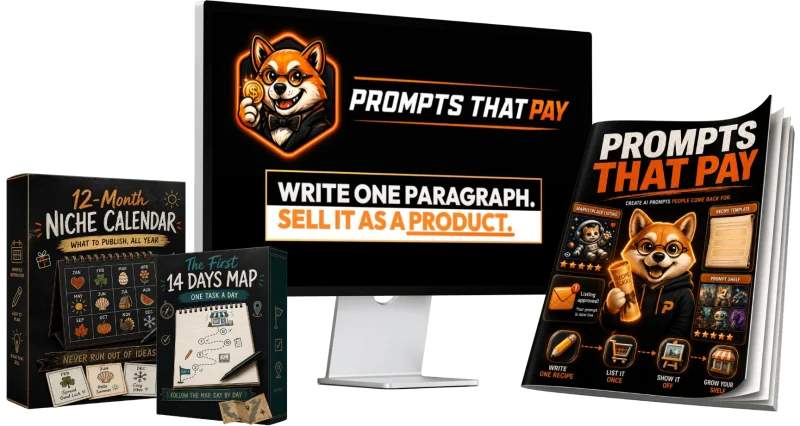
| Bonuses | The 12-Month Niche Calendar and The First 14 Days Map |
| Refund Period | 30 days |
| Skill Level | Beginner-friendly |
| Required Tools | ChatGPT account and marketplace account |
| Monthly Fee | No recurring fee for the training |
Because launch pricing can change, check the official checkout page before completing a purchase.
What Is Prompts That Pay?
Prompts That Pay is an online playbook that teaches people how to create reusable ChatGPT image prompts and package them as products for a prompt marketplace.
The distinction between a prompt product and an ordinary AI-generated image matters.
An image is a finished output. A prompt template is a reusable recipe. A customer can change selected variables, such as the subject, theme, color, character, product, or setting, and use the same template to produce new images.
For example, instead of selling one finished classroom poster, a seller might create a structured prompt that allows a buyer to generate classroom posters for different subjects. The customer is purchasing a repeatable creation method rather than one static file.
This can give a prompt template more practical value, but only when the instructions are clear and the results remain useful across multiple variations.
Prompts That Pay teaches the process required to develop that type of product and prepare it for marketplace review.
It is important to understand that this is not a standalone AI application. The main product is a private online guide with lessons, screenshots, case studies, checklists, and prompt workflows.
Who Created Prompts That Pay?
Prompts That Pay was created by Kevin Huynh, a digital-product creator whose work focuses on practical resources for beginners entering online product markets.
According to the product description, Huynh developed this training from a workflow he has used while selling prompt templates on the same marketplace for nearly two years.
The training also includes examples from a live shop, including a successful listing, a rejected submission, and a premium-pricing example.
These case studies may be more useful than generic prompting theory because they connect individual decisions with real listing situations. However, the creator’s results should not be interpreted as a promise that every buyer will achieve the same outcome.
What Problem Does Prompts That Pay Solve?
The challenge is not simply learning how to ask ChatGPT for an image.
Most ChatGPT users can type a basic image request. Far fewer know how to turn that request into a structured, reusable product that another person would pay to use.
Several problems appear during that transition:
- Choosing a niche with genuine buyer interest
- Developing a prompt that produces repeatable results
- Deciding which variables customers should change
- Generating strong examples for the product gallery
- Writing a clear, buyer-focused description
- Configuring a seller account and payout information
- Understanding submission and approval requirements
- Avoiding preventable rejection reasons
- Pricing and positioning the product appropriately
Prompts That Pay attempts to solve these problems with a repeatable workflow rather than leaving users to piece together disconnected tutorials.
That structure is likely to be most valuable for beginners. Experienced prompt sellers may already understand much of the core process, although the case studies and rejection guidance could still offer useful ideas.
What Do You Get Inside Prompts That Pay?
The front-end includes the main online playbook, the Assembly Line workflow, real examples, future updates, and two downloadable bonuses.
Sell Recipes, Not Pictures
This lesson explains the underlying product model.
Instead of creating one image and trying to sell the finished result, you develop a reusable fill-in-the-blank prompt. Buyers can modify the variable elements and generate a series of related outputs.
This approach can support product ideas such as:
- Educational posters
- Coloring pages
- Sticker sheets
- Printable wall art
- Children’s illustrations
- Journal pages
- Social-media graphics
- Marketing visuals
- Book illustrations
- Themed design collections
The practical value depends on how reliable and flexible the prompt becomes. A product that works only for one highly specific example is less useful than a template that performs across several relevant subjects.
The Marketplace Setup Training
Prompts That Pay reveals the covered marketplace inside the members area and provides setup guidance for the relevant screens.
The training is presented as more than a marketplace introduction. It includes account configuration, payout preparation, product listing steps, and submission guidance.
One limitation is that prospective buyers cannot fully evaluate the marketplace details before entering the course. They should therefore be comfortable with the fact that the specific platform and its complete requirements are revealed after purchase.
Why Listings Die in Review
A useful prompt can still fail to get listed if it does not meet the marketplace’s standards.
This section examines preventable rejection reasons and includes an example of a rejected listing that was later corrected.
That is a practical inclusion because submission requirements are often where beginners lose time. They may focus heavily on the prompt itself while overlooking preview images, formatting, variables, descriptions, or required listing fields.
No checklist can guarantee approval, however. Marketplace decisions remain outside the creator’s control, and policies may change.
The 10-Minute Niche Check
The niche-check process is intended to help users identify ideas before investing time in prompt development.
The method does not require a paid keyword-research subscription. That keeps the startup cost low and may suit beginners who are not ready to purchase specialist research software.
The phrase “profitable niche” should still be treated carefully. Research can reveal signs of interest or competition, but it cannot guarantee demand or sales.
A strong niche decision should consider:
- Whether buyers already purchase similar products
- Whether the prompt solves a recurring creative need
- How crowded the category appears
- Whether the output is visually demonstrable
- Whether the prompt can support meaningful variations
- Whether the seller can create a clear product gallery
The Assembly Line Workflow
The Assembly Line uses three copy-and-paste prompts to move from an initial idea to a more developed product template.
The first prompt generates ten possible ideas. The second helps remove weaker concepts. The third drafts a four-part prompt template.
This structure can reduce blank-page friction and prevent users from spending hours developing the first idea that comes to mind.
The screenshots showing actual runs should also make the lessons easier to follow. Nevertheless, users should not automatically publish the generated draft. They still need to test variables, inspect image quality, improve wording, and confirm that the prompt performs as intended.
Shop Setup Guidance
The guide covers seller-account configuration and payout setup.
This may seem like a minor section, but operational mistakes can delay publishing or payment. Beginners often benefit from having the administrative steps included in the same process as product creation.
Users remain responsible for meeting the marketplace’s identity, payment, tax, eligibility, and regional requirements.
Live-Shop Case Studies
The case studies include:
- A successful listing rebuilt step by step
- A real rejection and its correction
- A premium-price listing example
These examples can help users understand the reasoning behind a product rather than simply copying a finished template.
A case study is most useful when treated as a decision-making lesson. Copying the same niche, title, or prompt structure without independent testing could lead to generic products and unnecessary competition.
The Subscriber Switch
The playbook also discusses a dashboard feature intended to encourage repeat purchases or subscriber activity.
It covers where the setting appears, how the relevant pricing tiers work, and when the creator believes it should be activated.
This is a more advanced topic than simply submitting the first listing. Its inclusion shows that the course considers basic customer retention as well as initial product creation.
How Does Prompts That Pay Work?
The official workflow can be summarized in three main stages.
Step 1: Create a Reusable Prompt Recipe
You begin by choosing a specific type of image that a customer may want to generate repeatedly.
The prompt must do two things well:
- Maintain a recognizable output style or structure.
- Allow the customer to change meaningful variables.
For example, a sticker-sheet prompt may keep the same visual style while allowing users to replace the animal, profession, holiday, or hobby.
The training helps users brainstorm ideas, filter weak concepts, draft the prompt, and decide how the variable structure should work.
Why this matters: A reusable product needs consistency and flexibility. Too little flexibility reduces its usefulness. Too much flexibility may produce unpredictable results.
Expected result: A draft prompt template that can generate a recognizable family of images.
Common mistake: Treating the first successful image as proof that the prompt is ready to sell. A marketplace product should be tested across multiple variable combinations.
Step 2: Generate the Showcase Images
The next stage is to test the prompt and create examples for the listing gallery.
You generate several outputs, compare the results, and select the strongest examples. These images demonstrate what a buyer could create after purchasing the prompt.
A good gallery should show both quality and range. If every example uses nearly identical subjects, customers may not understand the template’s flexibility.
Why this matters: Buyers cannot judge a hidden prompt directly. The preview images become the main evidence of its usefulness.
Expected result: A set of strong examples that clearly represent the prompt’s output.
Common mistake: Selecting only the most attractive image while ignoring whether the remaining examples are consistent.
Step 3: Package and Publish the Listing
The final stage covers the product page and submission.
You organize the prompt, write the listing description, add the required information, review the pre-publishing checklist, and submit the product for approval.
The training includes guidance intended to reduce preventable rejection problems.
Why this matters: A strong prompt can still fail if buyers do not understand what it creates or if the submission is incomplete.
Expected result: A complete prompt listing submitted to the marketplace.
Common mistake: Assuming that submission means immediate publication. Approval may require additional time, and the marketplace may request changes or reject the listing.
What Types of Products Could You Create?
Prompts That Pay focuses primarily on image-prompt templates.
Possible categories include:
Printable and Educational Prompts
These could generate classroom posters, worksheets, visual learning aids, flashcard graphics, educational diagrams, or themed activity pages.
The main audience may include teachers, homeschool creators, printable sellers, and educational-content publishers.
Coloring and Activity Prompts
A reusable template could create coloring illustrations across multiple subjects, age groups, or visual themes.
Sellers should test line quality, composition, unwanted shading, and subject consistency before publishing.
Sticker-Sheet Prompts
These prompts may create coordinated collections based on animals, hobbies, seasons, professions, characters, or events.
A useful template should clearly separate elements and maintain a consistent illustration style.
Print-on-Demand Design Prompts
Potential outputs include T-shirt graphics, pattern concepts, SVG-style visuals, wall-art themes, and merchandise illustrations.
Users should review the terms of the relevant AI tool, marketplace, and production platform before using generated assets commercially.
Social-Media and Marketing Prompts
Templates could support promotional visuals, branded illustrations, ad concepts, UGC-style scenes, or themed social graphics.
These may appeal to business owners and marketers who need repeated variations rather than one finished image.
Who Is Prompts That Pay Best For?
Beginners Exploring Digital Products
The structured lessons may help beginners understand how an idea becomes a sellable listing.
The low stated front-end price and use of free accounts can also reduce the initial financial barrier.
ChatGPT Users Interested in Prompt Selling
People who already create images with ChatGPT but have never packaged their prompts may find the product-development framework more useful than general AI training.
Printable, KDP, Etsy, and POD Creators
Creators in adjacent markets may be able to apply their existing niche knowledge to prompt products.
Someone who understands classroom resources, for example, may have a better sense of what teachers want than a seller choosing random prompt niches.
Freelancers and Designers
Freelancers could use the workflow to organize prompt templates for their own projects or potentially develop prompt-based deliverables, subject to the relevant license terms.
Existing Prompt Sellers Who Lack a Process
Sellers who create products inconsistently may benefit from the niche check, Assembly Line, gallery preparation, and submission checklist.
Who Should Avoid Prompts That Pay?
Prompts That Pay may not be the right choice for:
- People expecting a fully automated business
- Buyers who do not want to use ChatGPT
- Users unwilling to test and improve AI output
- Anyone expecting guaranteed marketplace approval
- Buyers expecting guaranteed sales or income
- Experienced prompt sellers who already have a proven workflow
- Users who want downloadable desktop software
- People who need the full course as an offline PDF
- Sellers unwilling to follow changing platform policies
- Buyers who do not want to create product examples or listings
The main playbook simplifies the process, but it does not remove the need for implementation.
Prompts That Pay Pricing
The Prompts That Pay front-end offer is listed at $17 as a one-time payment during the launch period.
The stated regular price is $39.
The purchase includes:
- The complete online playbook
- Lifetime access
- Future updates
- The Assembly Line workflow
- Marketplace setup guidance
- Niche research lessons
- Rejection and approval guidance
- Live-shop case studies
- The 12-Month Niche Calendar
- The First 14 Days Map
- A 30-day money-back guarantee
There is no recurring fee for the main training.
The main course remains online rather than being delivered as a downloadable PDF. This format allows the creator to update the material and include interactive checklists. The two launch bonuses are described as downloadable files.
Prompts That Pay OTOs and Upgrades
The optional upgrades are not necessary to learn the core method. They mainly add automation, niche coverage, additional product formats, or resale rights.
OTO 1: The 10 Prompt Machines — $27
This upgrade includes ten niche-specific Custom GPTs.
The covered categories include:
- Logos
- Sticker sheets
- Coloring pages
- Seamless patterns
- Anime avatars
- T-shirt graphics
- UGC ads
- Watercolor portraits
- SVG cut files
- Comic panels
Each machine is designed to turn a topic into:
- Three title ideas
- A buyer-focused description
- One master prompt
- Nine worked examples
- Fifty possible swap values
The tools are described as working inside a free ChatGPT account without API keys or per-use fees.
Best for: Users who understand the core method but want to reduce repetitive drafting work.
Consider first: AI-generated listing copy and prompts still require testing and editing. A fast draft is not necessarily a marketplace-ready product.
OTO 2: The Complete Studio — $57
The Complete Studio expands the collection to 112 niche-specific Prompt Machines.
It adds categories related to planners, journals, classroom materials, cards, wall art, printables, POD products, and other digital-product markets.
Best for: Sellers who intend to build a larger catalog across several niches.
Consider first: Owning more machines does not automatically create a focused shop. A smaller, coherent catalog may be easier to position than a large collection of unrelated products.
OTO 3: Midjourney & Agent Skills Expansion — $67
This upgrade includes:
- Fifty-five Midjourney Prompt Machines
- A ChatGPT Agent Skill Builder
- A Claude Agent Skill Builder
The Midjourney machines follow a similar product-building format, while the skill builders are presented as tools for preparing SKILL.md files, triggers, permitted tools, examples, and installation instructions.
Best for: Users who want to expand beyond ChatGPT image prompts into Midjourney products or agent-skill resources.
Consider first: This upgrade introduces additional product types and may require more technical understanding. Buyers should also confirm current account and platform requirements.
OTO 4: Reseller License — $97
The reseller upgrade provides rights to sell 169 Prompt Machines under the buyer’s own brand, subject to the supplied license terms.
The package is described as including:
- Signed license certificates
- A reseller command center
- A Google Sheet delivery system
- Customizable sales pages
- A niche-pack builder
- Promotional materials
- Rights to create smaller bundles
- No royalties or monthly reseller fees
Best for: Marketers who specifically want to sell ready-made AI tools rather than create individual prompt listings.
Consider first: Buyers should read the full license agreement carefully. They should confirm branding rights, modification rules, support responsibilities, prohibited claims, delivery obligations, and any restrictions on marketplaces or advertising channels.
Prompts That Pay Pros and Cons
Pros
- Covers the complete publishing process: The training connects niche selection, prompt creation, example generation, listing preparation, seller setup, and submission.
- Designed for beginners: The workflow is broken into practical stages rather than assuming previous experience in digital-product publishing.
- Low initial tool requirements: The core process is described as requiring a free ChatGPT account and a free marketplace account.
- No recurring charge for the training: The front-end uses a one-time payment model and includes future updates.
- Includes real listing examples: The live-shop examples and rejected-listing case study can make abstract lessons easier to understand.
- Focuses on reusable products: A well-designed prompt template can provide repeat value to buyers compared with a single static image.
- Includes implementation bonuses: The niche calendar and 14-day map may help buyers move from learning to publishing.
- Refund period included: The 30-day money-back guarantee provides time to evaluate the training, subject to the official refund terms.
Cons
- It is training, not standalone software: Users must perform the research, testing, listing preparation, and submission themselves.
- The marketplace is revealed after purchase: Prospective buyers do not receive the complete marketplace details before entering the members area.
- No sales or approval guarantees: Marketplace acceptance and customer demand remain outside the creator’s control.
- AI outputs require quality control: Prompt results may vary. Sellers need to review image quality, consistency, accuracy, and suitability.
- The main training is not a downloadable PDF: Users who prefer fully offline learning may find the online-only format less convenient.
- Optional upgrades can increase the total cost: The front-end is inexpensive, but buying all four upgrades raises the full funnel cost to $265 before any taxes or price changes.
- Platform policies may change: Marketplace requirements and AI-platform terms can evolve, making future updates important.
Is Prompts That Pay Legit?
Prompts That Pay appears to be a legitimate educational product with a clearly defined purpose: teaching users how to develop and submit reusable AI image-prompt products.
The offer explains what the front-end includes, distinguishes the training from software, outlines its optional upgrades, and explicitly states that it does not guarantee income.
Those are positive transparency signals.
The more important question is not simply whether the product is legitimate. It is whether the training matches your needs.
It may provide good value when you:
- Are new to prompt selling
- Want a structured process
- Prefer practical screenshots and case studies
- Are willing to test and improve products
- Understand that marketplace results are uncertain
It may provide less value when you already sell prompts successfully or expect the system to create and manage the business without your involvement.
Can You Really Make Money With Prompts That Pay?
It is possible to sell prompt templates, but buying Prompts That Pay does not create income by itself.
Results will depend on factors such as:
- Niche demand
- Prompt quality
- Output consistency
- Product presentation
- Marketplace competition
- Pricing
- Approval status
- Customer reviews
- Catalog size
- Ongoing improvement
- Changes to AI and marketplace policies
The product teaches a business model and implementation process. It does not control the market.
A realistic goal for a beginner is to use the playbook to create, test, and submit a first professional listing. After that, the seller can study feedback, improve weak products, explore related niches, and gradually build a coherent catalog.
That is more credible than expecting immediate passive income from one prompt.
Prompts That Pay Alternatives
Free Tutorials and Marketplace Documentation
Free resources may be enough for experienced ChatGPT users who are comfortable researching rules and assembling their own workflow.
This route costs less but may take longer, and the information can be scattered or outdated.
General Prompt-Engineering Courses
A broad prompt course may teach deeper prompting principles across writing, research, coding, images, and automation.
Choose this option when your main goal is improving AI skills rather than selling prompt products.
Creating Traditional Digital Downloads
Etsy printables, KDP books, templates, stock graphics, and POD designs may suit creators who prefer selling finished products instead of prompt recipes.
These models often require more design, formatting, or production work but may offer access to different customer groups.
Building Custom GPTs
Custom GPT creation may appeal to users who want to package interactive workflows rather than individual image-prompt templates.
This can be more flexible, although platform access, distribution rules, and monetization options may differ.
Frequently Asked Questions
What is Prompts That Pay?
Prompts That Pay is an online playbook that teaches users how to create reusable ChatGPT image-prompt templates, prepare examples, package them as digital products, and submit them to a prompt marketplace.
Is Prompts That Pay software?
No. The front-end is an educational online guide rather than a standalone software application.
How much does Prompts That Pay cost?
The stated launch price is $17 as a one-time payment. The listed regular price is $39. Pricing may change, so review the official checkout before purchasing.
Does it have monthly fees?
The main training does not have a recurring subscription fee. External platforms or optional services may have their own current terms.
Do I need ChatGPT?
Yes. The workflow is based on creating and testing ChatGPT image prompts. Official information states that a free ChatGPT account can be used for the core process.
Do I need design experience?
No formal design background is required. However, users still need to judge visual quality and choose effective showcase images.
Which marketplace does the course cover?
The specific marketplace is revealed inside the members area. The training includes account setup, listing preparation, and submission instructions for that platform.
Can I download the course as a PDF?
The main training remains online. The two launch bonuses are described as downloadable resources.
What are the Prompts That Pay bonuses?
The front-end includes The 12-Month Niche Calendar and The First 14 Days Map.
How quickly can I publish a listing?
The creator states that users may be able to prepare a submission in one focused afternoon. Actual completion time depends on experience, testing, editing, and the selected idea. Marketplace approval can take additional time.
Does Prompts That Pay guarantee approval?
No. The checklist is intended to reduce avoidable mistakes, but approval remains subject to marketplace review.
Does Prompts That Pay guarantee income?
No. Sales depend on execution, demand, competition, product quality, and other market conditions.
Are the OTOs required?
No. The front-end contains the core training and workflow. The upgrades add automation, additional niches, more product categories, or reseller rights.
Is there a refund guarantee?
The offer includes a stated 30-day money-back guarantee. Buyers should review the current refund terms and request procedure before purchasing.
Final Verdict
Prompts That Pay addresses a specific gap in the AI education market.
Many resources explain how to write prompts. Far fewer show beginners how to turn a prompt into a properly researched, tested, presented, and submitted digital product.
That end-to-end structure is the main reason to consider this playbook.
The Assembly Line can help users move from a broad idea to a workable template. The niche check may reduce time spent on weak concepts. The gallery guidance helps users demonstrate the product. The rejection examples and publishing checklist address the operational details that are easy to overlook.
The product still requires real work.
You need to choose suitable ideas, test multiple variations, inspect the outputs, prepare clear listings, follow marketplace policies, and continue improving the catalog. Neither the course nor its optional Prompt Machines can guarantee approval, traffic, customers, or income.
At the stated $17 front-end price, Prompts That Pay appears most valuable for beginners who want a focused roadmap and would otherwise spend considerable time piecing the process together from scattered tutorials.
Experienced prompt sellers may find the core material less essential. They may be more interested in the optional automation tools, although each upgrade should be evaluated against a specific catalog-building goal.
Overall, Prompts That Pay is worth considering when you want to explore AI prompt products with realistic expectations and a structured publishing process.
The sensible next step is to review the official offer, confirm the current price and refund conditions, and decide whether you are prepared to create and test the products rather than merely study the method.
Prompts That Pay is an online playbook that teaches users how to create reusable ChatGPT image-prompt templates, prepare examples, package them as digital products, and submit them to a prompt marketplace.
Product Brand:
Kevin Huynh
Product Currency:
USD
Product Price:
17
Product In-Stock:
InStock Prompts That Pay
4.4
(You will receive ALL Bonuses on Part 1 to Part 5)
PART 1
PART 2
PART 3
PART 4
PART 5
And you can pick 1 package (for each purchase) from the following packages that you think are the most useful for you:
And you can pick 1 package (for each purchase) from the following packages that you think are the most useful for you:
***3 STEPS TO CLAIM THIS BONUSES***
Step 1: Order Prompts That Pay Review through my Prompts That Pay Review:
Step 2: After you complete the order, send [the receipt id] in a message to my email at: support@tikareview.com or complete your information on this page.
Step 3: I will send all bonuses for you within 24 hours. Please wait your bonus.

