
ClawBooks AI Review 2026
Can It Really Simplify Interactive Publishing?
Creating the words is often the easy part of publishing an ebook, brochure, catalog, magazine, or lead magnet. The annoying work starts afterward.
You need to organize the pages, find suitable images, design a cover, keep the layout consistent, add links, make the result readable on mobile, publish it somewhere, and—if this is a marketing asset—give the reader a useful next step. What looked like “make an ebook” can quickly become a five-tool project.
That is why ClawBooks AI caught my attention. In this ClawBooks AI Review, I am looking at it less as another AI writer and more as an attempt to combine content generation, publication design, interactive elements, flipbooks, lead capture, and publishing inside one workflow.
The interactive side is what interests me most. ClawBooks AI can work with videos, GIFs, clickable CTAs, QR codes, lead forms, stock media, templates, and existing PDFs—not merely paragraphs generated by AI.
But there is an obvious question behind all of that: does it actually reduce the publishing work, or simply generate more material that you still have to clean up manually?
I have not treated the sales-page promises as hands-on results. Instead, I reviewed the demonstrated workflow and available product information to see what ClawBooks AI appears to remove from the process, what remains your responsibility, and whether the $37 front end gives you enough without forcing you into the upgrades.
Overview Of ClawBooks AI

| Product | ClawBooks AI |
| Creators | Dr. Amit Pareek & Atul Pareek |
| Product Type | AI interactive publication creator |
| Launch Date | September 15, 2026 |
| Front-End Price | $37 |
| Front-End Coupon | CB2 – $2 Off |
| Commercial License | Included |
| Guarantee | 30 Days |
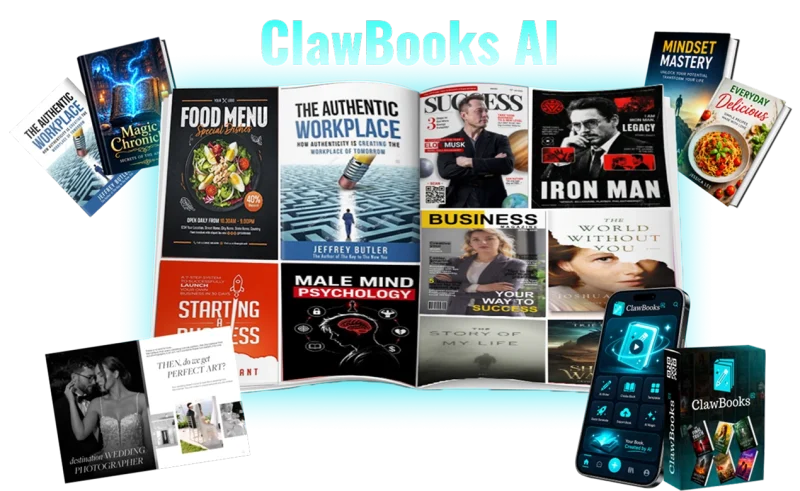
| Main Uses | Books, flipbooks, magazines, brochures, catalogs, menus, photo books and other digital publications |
| Platform | Cloud-based |
| AI Technology Mentioned | Claude, ChatGPT, Gemini and other AI models |
| Best For | Marketers, creators, freelancers, agencies, authors and small businesses |
ClawBooks AI enters the market as more than a prompt-to-ebook generator. The front-end product combines AI-assisted creation with editing, interactive content, publishing, and commercial-use capabilities.
That distinction matters because generating text is no longer particularly difficult. Turning that text into something polished enough to give a customer, subscriber, or client is where much of the work remains.
What Is This App?
ClawBooks AI is a cloud-based AI publication creation platform that lets you build digital publications from several different starting points.
You can work from a keyword or instruction, speak a command, use a URL, upload a PDF, or work with images. The platform can then be used for books, magazines, brochures, menus, catalogs, photo books, flipbooks, and other visual publications.
Existing PDFs are particularly interesting because they do not necessarily have to be recreated from scratch. ClawBooks AI includes a PDF-to-flipbook workflow, giving existing material another route into the platform.
The finished publication can also go beyond static pages.
ClawBooks AI supports elements including videos, GIFs, images, CTA buttons, QR codes, and lead-capture forms. It also provides templates, a cover-design workflow, a drag-and-drop editor, and access to a large searchable stock-media library.
So I would describe the core idea this way: ClawBooks AI tries to connect AI content creation with the work that normally happens after AI has generated the content.
That is a more compelling proposition than simply “AI writes books.”
The Main Idea Behind ClawBooks AI
Most AI content tools stop surprisingly early.
You enter a prompt.
You receive text.
Then the real production process begins.
You move the copy into another application, format it, find images somewhere else, create the cover, build links, export the document, upload it to a flipbook platform, and possibly connect another system if you want to collect leads.
ClawBooks AI attempts to shorten that chain.
The workflow shown for the product revolves around giving the system an instruction and then developing the resulting publication inside the same environment. The dashboard covers AI books, flipbooks, photo books, templates, leads, clients, teams, and related publishing functions.
That does not mean every publication suddenly becomes one-click work.
I would still separate generation from publication.
Generation gets something onto the screen.
Publication means checking whether that something is accurate, useful, readable, visually coherent, and appropriate for the audience.
ClawBooks AI can help considerably with the first part and provide tools for the second. The final judgment still belongs to you.
Who’s Behind The Creation?
ClawBooks AI was co-founded by Dr. Amit Pareek and Atul Pareek.
They have previously released software products in areas including AI content creation, marketing, automation, presentations, video, and online business.
The product information identifies previous launches such as GPT Apps Engine, Insta Engine AI, Prezent IQ, Ultimate AI, InkFlow, Tube Engine AI, Agentic AI, Pitchora AI, WriterArc, Sigma AI, Delta AI, and Synthetic AI.
For this type of product, that history is useful context because ClawBooks AI is hosted software rather than a downloadable information product.
Still, I would never buy software purely because I recognize the vendor.
The workflow and usefulness of this particular product matter more.
The Features Of ClawBooks AI
There are plenty of features attached to ClawBooks AI, but a long feature list does not automatically produce a good publishing tool.
These are the capabilities I think have the clearest practical impact.
Start With An Idea, URL, PDF Or Images
Not everyone arrives with the same raw material.
Someone creating a new lead magnet might have nothing but a topic. An agency could already have a client’s PDF brochure. A restaurant might have images and an old menu. A consultant might want to repurpose existing online material.
ClawBooks AI supports several entry points, including keywords or commands, URLs, PDFs, and images. Voice input is also part of the workflow.
That flexibility matters because it makes the platform useful for both creation and repurposing.
I would still be specific with AI instructions. “Create a marketing ebook” leaves far too many decisions to the model.
Who is reading it? What should they learn? What action should they take afterward? What tone fits the brand?
The better those decisions are before generation, the less cleanup you are likely to face afterward.
Turn Existing PDFs Into Flipbooks
I think this is one of the easier features to understand commercially.
ClawBooks AI can convert an existing PDF into a flipbook.
You therefore do not have to generate a new book every time you use the platform.
An existing:
- brochure
- product guide
- menu
- catalog
- lead magnet
- report
- portfolio
can potentially become an interactive publication.
For freelancers and agencies, that creates a straightforward client service as well.
You can work with assets businesses already own rather than convincing every client to commission entirely new content.
Make Publications Interactive
This is probably the feature group I would pay the most attention to.
ClawBooks AI supports videos, GIFs, images, CTA buttons, lead forms, and QR codes within its publication workflow.
Think about the difference with a catalog.
A traditional catalog says:
“Here is the product.”
An interactive catalog can potentially say:
“Here is the product. Watch it being demonstrated. Now click here for the next step.”
The same applies to lead magnets.
Instead of treating an ebook as the end of a funnel, you can potentially make it part of the funnel.
That is useful—but only when the interaction has a purpose.
I would not put a video, form, GIF, button, and QR code on a page merely because they are available. The publication should still feel like something created for the reader, not a collection of widgets.
Edit Instead Of Accepting The First AI Draft
This sounds obvious. It is not.
One of my biggest problems with “one-click” AI tools is the implication that the first generated output should also be the final output.
ClawBooks AI includes a drag-and-drop editor, templates, and cover-design capabilities, which means generation does not have to be the end of the workflow.
This is where I would slow down.
- Read the text.
- Look at the spacing.
- Check whether images actually support the content.
- Remove generic sections.
- Check the CTA.
- Make sure the cover does not look disconnected from the inside pages.
AI is very good at getting you away from zero. Human editing is what decides whether the finished project deserves to be published.
Find Visual Assets Without Leaving The Workflow
ClawBooks AI includes access to a searchable library advertised at more than 15 million stock images, videos, and vectors.
I would not buy the product solely for this feature.
What I like is where it sits in the workflow.
If you can search for appropriate media while building the publication, you avoid repeatedly visiting stock sites, downloading files, organizing them locally, and uploading them again.
For a single image, who cares?
For a 40-page visual publication, that friction starts adding up.
Work With Multiple AI Models
The product materials mention Claude, ChatGPT, Gemini, and other AI models as part of the AI engine.
That sounds impressive, but I consider the model names secondary.
I care more about the workflow built around them.
You can already access excellent general-purpose AI tools separately. ClawBooks AI becomes useful when those AI capabilities are connected to publication creation, editing, media, and distribution.
In other words, I would not buy it to “get AI.”
I would buy it to organize what AI does into a specific publishing job.
Publish, Embed And Control Access
ClawBooks AI also covers the other end of the workflow: getting the finished publication in front of people.
The documented feature set includes publishing and embedding options, public and password-protected access, QR codes, social sharing, and custom branding/domain capabilities.
Password protection could be useful for private client material, paid resources, internal documents, premium publications, or restricted presentations.
Custom branding becomes more important when you are selling publication services to businesses.
Again, those features become more valuable as you move from hobby use toward commercial work.
Add my code “CB2” to get $2 off.
How Does ClawBooks AI Work?
The workflow starts from the main ClawBooks AI dashboard.
From there, the demonstrated system provides access to AI books, flipbooks, photo books, templates, leads, clients, teams, and other project-management areas.
Step 1: Choose Your Publication
First, decide what you are actually building.
That could mean starting an AI-generated book, working with an existing PDF, or choosing another supported publication format.
I would decide the final purpose before touching the AI.
A lead magnet needs a different structure from a restaurant menu. A catalog needs different calls to action from an educational guide.
Step 2: Give The AI Your Input
The AI Book Agent allows users to enter a command, including commands in different languages. Voice input and ready-made command ideas are also demonstrated.
This is where specificity pays.
Do not just describe the subject.
Describe the reader and the objective.
Step 3: Generate The Initial Publication
The system uses your input to create the initial publication.
This removes the blank-page stage, which is one of the most useful things AI can do in a creative workflow.
I would call this the first draft, however—not the finished asset.
Step 4: Review And Edit
Now inspect the generated material in the editor.
This is where you correct content, change layouts, adjust visuals, improve covers, and make the publication feel intentional rather than automatically assembled.
If I were creating something for a client, this is where most of my attention would go.
Step 5: Add Interaction Where It Helps
You can then add relevant interactive elements such as video, GIFs, buttons, QR codes, or lead forms.
Do not ask, “What else can I add?”
Ask, “What should the reader do next?”
That usually produces a better publication.
Step 6: Publish And Share
After reviewing the final version, you can use the available publishing, embedding, sharing, QR-code, and access-control options to distribute it.
Before doing that, I would test everything.
- Open it on mobile.
- Click the buttons.
- Test forms.
- Watch embedded media.
- Read the publication from beginning to end.
AI can build the wrong thing remarkably quickly. The final check is still yours.
To see the platform in action, be sure to check out the full demo video below:
Add my code “CB2” to get $2 off.
Who Should Try ClawBooks AI?
ClawBooks AI has a fairly broad audience, but some groups have a clearer reason to use it than others.
Affiliate marketers can create buyer guides, reports, lead magnets, ebooks, and promotional publications with embedded next steps.
Freelancers can turn publication creation and PDF-to-flipbook conversion into client services.
Agencies have an even stronger use case when publications are part of recurring client campaigns.
Small businesses can use the platform for catalogs, brochures, menus, product guides, and similar customer-facing material.
Authors and creators can use AI to accelerate the early creation process while retaining an editing environment for the finished asset.
Coaches and consultants can create guides, resources, reports, and lead-generation material around their expertise.
I would be less enthusiastic if your only requirement is generating text. You do not need an interactive publication platform for that.
Professional graphic designers may also prefer dedicated design applications when pixel-level control is more important than automation.
What Makes This App A Contender For Your Consideration?
ClawBooks AI becomes more convincing when I stop looking at individual features and look at the number of handoffs it potentially removes.
A typical project might involve:
AI writer → document application → stock-media website → graphic-design tool → PDF export → flipbook service → form builder → publishing platform.
Each tool can be good at its own job.
The problem is you become the integration.
You copy. Download. Upload. Resize. Export. Reopen. Reformat. Repeat.
ClawBooks AI’s strongest proposition is reducing some of that movement.
For an occasional ebook, the difference may not be dramatic.
For somebody producing assets every week—or producing them for clients—it becomes considerably more interesting.
The commercial license included with the front end reinforces that use case.
The limitation is that consolidation does not equal perfection.
A specialist graphic-design platform may provide more control. A dedicated AI writer may provide a deeper writing environment. A specialist lead-generation platform may have more sophisticated forms and automation.
ClawBooks AI is appealing because those pieces are connected around one job.
That job is creating interactive publications.
User Experience
Based on the demonstrated workflow, ClawBooks AI is organized around a central dashboard rather than making users assemble a publication through unrelated external applications.
The AI Book Agent appears to reduce the initial setup burden substantially because you can describe what you want rather than manually constructing every page from a blank canvas.
But I would not confuse fewer initial steps with zero learning curve.
There are a lot of capabilities here.
AI books, flipbooks, photo books, templates, interactive elements, media, leads, clients, teams, publishing options, and additional business functions mean new users still need to understand which parts actually matter to their workflow.
My approach would be deliberately boring:
- Create one simple publication first.
- Ignore everything you do not need.
- Learn the editor.
- Publish something.
- Then explore the deeper features.
Trying to use every tool in the first project is usually how “all-in-one” software starts feeling complicated.
Why Is It Worth Checking Out?
There are three reasons I think ClawBooks AI deserves consideration.
First, it tackles more than content generation.
AI writing is becoming a commodity. The harder problem is turning generated material into something usable.
Second, it has genuine repurposing potential.
Being able to work with PDFs, URLs, images, and existing material means you are not forced to generate every publication from scratch.
Third, the commercial license changes the economics for freelancers and agencies.
If you can use the platform to produce client brochures, catalogs, interactive PDFs, menus, lead magnets, and similar assets, you are evaluating a production tool rather than merely buying an ebook generator.
There is still one thing ClawBooks AI cannot solve for you:
Why should anybody read the publication?
You still need a useful topic, appropriate audience, distribution strategy, offer, and reason for the reader to care.
Production software solves production.
It does not solve the entire business.
The Price
The ClawBooks AI front-end offer is ClawBooks AI Commercial at $37 as a one-time payment during the launch promotion.
You can use coupon:
CB2 – Save $2 on the front end.
The commercial license is included, making the front end suitable for users who want to create projects for clients as well as their own businesses.
A 30-day money-back guarantee is also listed for the offer.
For most new buyers, I would start here.
The front end gives you the core creation workflow. That is what you need to evaluate first.
- Do you like the AI generation process?
- Can you edit the result comfortably?
- Are the interactive elements useful for your projects?
- Does the publishing workflow replace enough of your existing tool chain?
Those questions matter before deciding whether an upgrade deserves more money.
The OTO Details
The ClawBooks AI launch funnel contains five main upgrades after the Commercial edition.
I would treat them like a menu.
You do not win anything by ordering everything.
OTO 1 – ClawBooks AI Enterprise – $27 >>More Details<<
The Enterprise upgrade costs $27.
This upgrade expands ClawBooks AI beyond the basic Commercial setup for users who need the additional Enterprise-level capabilities provided in the funnel.
The important buying question is whether the front-end limitations are actually getting in your way.
If you are an individual creator making a few publications, I would start with Commercial and see how far it takes you.
If you are moving toward heavier business use, more projects, client work, or the additional Enterprise functions specifically solve a limitation you encounter, this becomes easier to justify.
Do not upgrade because “Enterprise” sounds better.
Upgrade when your workload needs it.
OTO 2 – ClawBooks AI Template Club – $47 >>More Details<<
The Template Club upgrade costs $47.
This upgrade is aimed at users who want additional ready-made design resources and greater template variety for ongoing publication creation.
I see the clearest value for:
- agencies producing different client assets
- freelancers creating publications repeatedly
- marketers running multiple campaigns
- businesses that need fresh visual styles regularly
If you create one or two publications, you may be perfectly happy with the resources already available to you.
If you create twenty, design variety becomes a different problem.
That is when Template Club makes more sense.
OTO 3 – ClawBooks AI Profit Engine – $47 >>More Details<<
The Profit Engine upgrade costs $47.
This part of the funnel is aimed more directly at users who want to build a commercial or monetization workflow around what they create with ClawBooks AI.
That immediately makes it more relevant to marketers, freelancers, agencies, and people treating ClawBooks AI as a business tool.
A small business owner who simply wants an interactive catalog may not need it.
A freelancer asking, “How can I turn this software into a repeatable service?” has a stronger reason to examine it.
I would buy this upgrade for a defined monetization use case, not because an income-oriented OTO name sounds attractive.
Software can give you the infrastructure.
Finding customers and delivering work people will pay for remains your responsibility.
OTO 4 – ClawBooks AI DFY Service – $97 >>More Details<<
The DFY Service upgrade costs $97.
This is the convenience-oriented option for users who want more done-for-you assistance rather than building every part of the implementation themselves.
The value depends heavily on your time and confidence.
If you enjoy setting up campaigns, adjusting assets, and learning software, I would be slower to spend the extra $97.
If your bottleneck is implementation rather than ideas, paying for done-for-you resources can make more sense.
This is especially relevant to people who value speed of deployment over learning every part of the setup process.
I would still inspect anything done for you.
DFY means less setup.
It should never mean “publish without checking.”
OTO 5 – ClawBooks AI Whitelabel – $97 >>More Details<<
The Whitelabel upgrade costs $97.
This is the most specialized upgrade in the funnel.
Whitelabel functionality is mainly relevant to agencies, service providers, software marketers, and businesses that specifically want to present the solution under their own brand rather than simply use ClawBooks AI internally.
For a blogger creating ebooks?
Skip it.
For a restaurant building its own menu?
Skip it.
For an individual marketer creating lead magnets?
Probably skip it.
For an agency where branding and resale positioning are part of the business model?
Now it becomes worth investigating.
That is exactly how I think OTOs should be evaluated: the upgrade should solve a problem you actually have.
The Bundle Offer
The ClawBooks AI Bundle costs $367 and packages the front-end product plus OTO 1 through OTO 5 into one purchase.
The available bundle coupon is: CB100 – Save $100 on the Bundle.
That can materially change the bundle economics, but I would still apply the same rule.
Do you actually need the package?
A serious agency, publication service provider, or marketer planning to use the Enterprise, template, monetization, DFY, and whitelabel components may find the bundle easier than assembling the funnel separately.
A first-time user who mainly wants to see whether AI-assisted interactive publishing works for them has a much simpler option:
Start with the $37 Commercial edition.
The bundle is the broader business package.
The front end is the lower-risk way to test the core product.
Those are two different buyers.
Use Discount Coupon “CB100” For Instant $100 OFF
Pros & Cons
Pros
- Supports several publication types rather than only ebooks.
- Can start from keywords, commands, URLs, PDFs, or images.
- Voice input adds another way to begin a project.
- Existing PDFs can be converted into interactive flipbooks.
- Interactive elements include video, GIFs, CTA buttons, QR codes, and lead forms.
- Drag-and-drop editing means the first AI generation does not have to be the final version.
- Ready-made templates reduce blank-canvas design work.
- Large searchable stock-media library is built into the workflow.
- Publishing and embedding tools keep more of the process inside one platform.
- Password protection expands potential use cases.
- Mobile access is useful for starting or managing projects away from a desktop.
- Commercial license is included with the front end.
- $37 one-time front-end price gives buyers a relatively inexpensive way to test the central workflow.
Cons
- AI-generated content still needs human fact-checking and editing.
- Good layout and visual hierarchy still depend on human judgment.
- Buyers who only need AI writing will not use much of the platform.
- Professional designers may prefer dedicated software for highly detailed visual control.
- Interactive features are only useful when they serve an actual reader or marketing objective.
- The complete upgrade funnel becomes substantially more expensive than the $37 entry price.
- Some advanced business use cases require considering additional upgrades.
- Creating a publication faster does not automatically create traffic, leads, customers, or sales.
Is ClawBooks AI Legit?
ClawBooks AI has a defined product workflow, identifiable creators, a documented dashboard, a front-end offer, commercial-use rights, optional upgrades, and a 30-day refund policy.
So yes, I consider it a legitimate software offer based on the information available.
But “legit” should not be confused with “guaranteed to work for everybody.”
The software addresses a genuine production problem: moving from an idea or existing content to a more polished and interactive digital publication without relying on as many disconnected tools.
What it cannot guarantee is demand.
- It cannot guarantee people will read your ebook.
- It cannot guarantee a catalog sells products.
- It cannot guarantee an agency finds clients.
- It cannot make weak information useful simply by wrapping it in a nice flipbook.
That is the healthy way to evaluate an AI publishing platform.
Judge it on the work it actually removes.
Is This A Good Match For Your Business?
I would ask yourself three questions.
Do you create publication-style assets regularly?
If yes, the integrated workflow becomes more valuable.
Do those assets have a commercial purpose?
If you are creating lead magnets, catalogs, client brochures, product guides, interactive reports, menus, or marketing publications, features such as CTAs, forms, QR codes, commercial rights, and embedding make considerably more sense.
Are you currently stitching several tools together to finish the job?
This may be the biggest question of all.
If your current process already feels simple, ClawBooks AI may not change much.
If your process involves generating copy in one place, designing somewhere else, searching for stock assets in another tab, exporting PDFs, uploading them elsewhere, and then adding separate lead-generation tools, consolidation has real value.
That is the user I think will notice ClawBooks AI the most.
Final Verdict
ClawBooks AI is not interesting because AI can generate another ebook.
We crossed that bridge a while ago.
It is interesting because it tries to handle what happens after the AI gives you the words.
The ability to move from an idea, URL, PDF, or images into an editable publication—and then add interactive media, CTAs, QR codes, lead capture, branding, and publishing—addresses a genuine gap between content generation and finished digital assets.
Its biggest advantage is therefore workflow consolidation.
Its biggest limitation is that consolidation does not eliminate judgment.
- You still decide what is accurate.
- You still decide what looks professional.
- You still decide which interaction helps the reader.
- You still need a distribution or business strategy once the publication exists.
For affiliate marketers, creators, freelancers, agencies, consultants, authors, and small businesses that regularly create digital publications, I think the $37 Commercial edition is a sensible place to start.
I would not automatically buy every OTO.
Use Commercial first. Learn the real workflow. Find the limitations that actually affect you. Then upgrade if Enterprise, additional templates, monetization resources, DFY assistance, or whitelabel capabilities solve a specific problem.
The Bundle makes more sense for a serious commercial user who already knows those additional components fit the business model.
For everyone else, start small.
That is ultimately where I land on ClawBooks AI: it looks most useful not as a magic one-click book machine, but as a practical way to reduce the number of separate steps between an idea and an interactive publication that is actually ready to put in front of people.
ClawBooks AI is an AI-powered digital publishing platform that helps users create interactive books, eBooks, flipbooks, magazines, brochures, catalogs, menus, and other publications from keywords, URLs, PDFs, images, or voice/text instructions. It combines AI content creation with editing, templates, multimedia, CTAs, QR codes, lead forms, and publishing tools in one workflow.
Product Brand:
Dr. Amit et al
Product Currency:
USD
Product Price:
37
Product In-Stock:
InStock ClawBooks AI
4.5
And you can pick 1 package (for each purchase) from the following packages that you think are the most useful for you:
***3 STEPS TO CLAIM THIS BONUSES***
Step 1: Order ClawBooks AI Review through my Synthetic AI Review:
Step 2: After you complete the order, send [the receipt id] in a message to my email at: support@tikareview.com or complete your information on this page.
Step 3: I will send all bonuses for you within 24 hours. Please wait your bonus.

