
Agentic Sites Review 2026
AI Website Builder Explained
Building a website is rarely just a “build the website” job anymore. You plan the offer, work out the pages, decide on branding, write the content, find hosting, connect a domain, keep publishing, and—if you are doing this for clients—somehow find businesses willing to pay you for all of that work.
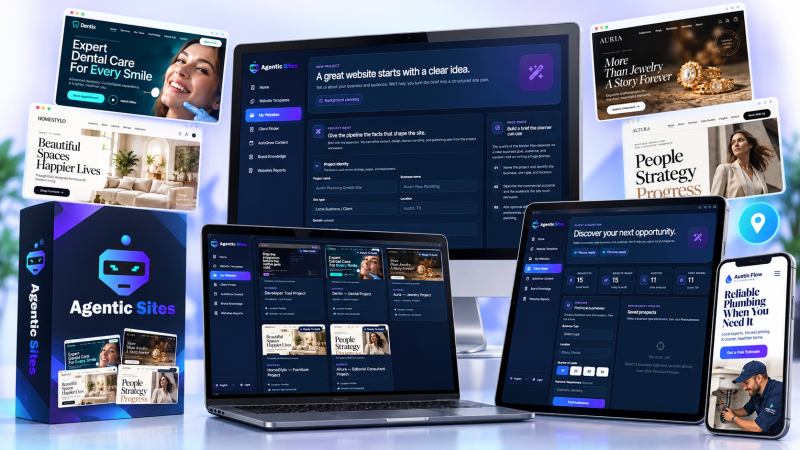
That fragmentation is what made Agentic Sites Review worth a closer look for me. Agentic Sites is trying to put more of that process into one AI-assisted system: planning the site, generating the structure, creating branding, editing pages, publishing them, adding future content, and even finding potential local-business clients.
What caught my attention is not simply the AI website builder. We already have plenty of those. It is the attempt to connect website creation with the business around the website. The same workspace can move from “What should I build?” to “How do I publish it?” and then into “Who could I sell this service to?”
That also raises the obvious question: does Agentic Sites actually reduce the work involved in running website projects, or does it simply automate the first draft while leaving most of the difficult decisions to you?
In this Agentic Sites review, I’ll break down what the platform does, its main features, how the workflow fits together, who I think will get the most value from it, the $19 front-end offer, the available upgrades, meaningful limitations, and whether the overall package makes sense for marketers, freelancers, affiliate site builders, and agencies.
Overview Of Agentic Sites

| Details | Information |
|---|---|
| Product | Agentic Sites |
| Creators | Anirudh Baavra & Amit Gaikwad |
| Product Type | AI website creation, publishing and client-acquisition platform |
| Launch Date | September 14, 2026 |
| Front-End Price | $19 one-time |
| Coupon | AGENT35 for 35% off the front end and listed OTOs |
| Guarantee | 30-day money-back guarantee |
| Best For | Freelancers, marketers, affiliate site builders, local-business service providers and small agencies |
| Main Strength | Combines website planning, creation, publishing, content and prospecting |
| Main Limitation | The front end has usage limits; heavier users are pushed toward Unlimited |
| Official Page | https://aiagenticsites.com |
The front-end information lists Agentic Sites at $19 as a one-time purchase, with the AGENT35 coupon reducing eligible front-end and upgrade purchases by 35%. A 30-day refund policy is also included.
What Is This App?
Agentic Sites is an AI-assisted website platform built around a larger workflow than the typical “type a prompt and generate a homepage” model.
You begin with the business idea, target audience, location and objective. The software can help turn that rough information into a clearer website brief, prepare a master plan for the site, create a visual identity, generate the pages and then give you a visual SiteBuilder for making changes before publishing.
That is the creation side.
There is also a growth side. You can maintain several projects separately, feed business-specific information into a Knowledge Hub, prepare ongoing content and schedule future posts.
Then there is a third layer aimed particularly at freelancers and agencies: searching for local businesses, checking their websites, running AI-assisted audits, scoring opportunities and generating personalized outreach messages.
That combination is the real identity of Agentic Sites.
I would describe it less as a pure website builder and more as a website production and client-service workspace. The individual features are useful, but the bigger idea is reducing the number of separate tools needed between finding an opportunity and getting a finished website online.
It does not remove human judgment. You still need to decide whether a business idea makes sense, review generated copy, check the design, decide what should be published and communicate properly with clients. AI can accelerate those decisions. It should not be making all of them for you.
Who’s Behind Agentic Sites?
Agentic Sites was created by Anirudh Baavra and Amit Gaikwad.
Their recent product history includes projects such as Auto Browse AI, Smart AI Manager and AI Video Studio, giving them experience across AI automation, digital assets and online-business software.
That background is relevant because Agentic Sites sits at the intersection of several areas: AI generation, website development, online marketing and agency-style client work.
For me, creator history matters more with platforms like this than with a simple PDF course. A hosted website system depends on continued infrastructure, maintenance and development. Agentic Sites is not merely delivering downloadable files; users are relying on an operating platform.
The Features Of Agentic Sites
The easiest mistake here would be to look at the feature count and conclude that more automatically means better. It does not. What matters is whether the features remove separate pieces of work from a real website project.
That is where several parts of Agentic Sites make sense.
Agentic AI Website Planning
Starts before page creation. You provide details such as the business idea, audience, location and goal, giving the system context for what it is supposed to build.
That sounds like a small distinction, but it matters. A website generated from “make me a plumber website” is likely to be generic. A website built around a particular service, audience, location and conversion goal at least begins with a usable strategy.
Smart Brief Assistant
Helps refine the initial business description. You do not have to arrive with a perfectly written creative brief. That should be especially useful for beginners or for client work where the information you receive is messy.
I would still treat the brief as a strategic document rather than something to accept blindly. Bad context fed into a sophisticated builder is still bad context.
Master Plan Generation
Takes the brief and maps out positioning, recommended pages and the overall content direction.
This is one of the pieces I like conceptually because page generation is not usually the hardest part of website work anymore. Deciding which pages belong there and what each one is supposed to accomplish is often the bigger problem.
AI-Powered Brand Kit
Creates a coordinated combination of colors, fonts and brand voice for the project.
For a freelancer producing several smaller business websites, keeping this inside the same project is convenient. You are not jumping into a separate branding tool just to decide on a visual starting point.
Again, starting point is the key phrase. A generated palette and typography system can establish consistency, but a serious brand may still need deeper creative direction.
Visual SiteBuilder
Lets you open the generated website and modify the result rather than being locked into whatever the AI produces.
This feature matters much more to me than another generation button.
The first AI version of a site should be treated as draft material. Read the copy. Check the calls to action. Look at the spacing. Make sure a local dental clinic does not sound like a SaaS startup because the model got enthusiastic.
Fast generation only becomes genuinely useful when editing remains practical.
Multi-Project Workspace
Keeps different websites separated inside the same account. That is relevant for anyone juggling a business site, affiliate projects and several clients.
Business Knowledge Hub
Lets users provide project-specific material through text, URLs and PDFs. That information can then give the AI more relevant context when generating content.
This may be one of the most useful features for client projects.
A local business normally has existing services, positioning, policies, terminology and company information. Feeding those sources into the project is considerably more sensible than asking generic AI to invent everything from scratch.
Human checking still matters. A knowledge source improves context; it does not guarantee factual output.
AI Content Workflow
Extends the site beyond launch day. Users can work from topics and keywords, prepare new content and schedule posts for the relevant website.
That changes Agentic Sites from a one-off builder into something closer to an ongoing website management environment.
If you run content sites, affiliate properties or SEO-focused local sites, that continuity is more interesting than generating five attractive pages and never touching them again.
The agency-oriented features take the product in a different direction.
Local Business Lead Finder
Searches for businesses by niche and location.
Website Confirmation And AI Audits
Help associate a prospect with the correct website and analyze areas including SEO and mobile performance.
Opportunity Scoring
Organizes those findings so you can prioritize businesses that appear to have stronger website problems.
Personalized Pitch Generator
Then uses audit information as context for creating an outreach subject line and message.
This sequence is more useful than a plain database of local businesses.
A name and phone number are not much of a sales argument. Finding a business, identifying an actual website issue and then building an outreach message around that issue is at least a more relevant starting point.
I would still rewrite the outreach before sending it. AI-generated cold email has a recognizable smell when everyone sends the untouched version.
Agentic Sites also includes AI-assisted templates for local-business, content/blog and affiliate projects, giving you a structural starting point instead of a blank page.
HTML Build And Deployment
When the site is ready, HTML build and deployment moves the project toward publication.
Free hosting is included, which potentially removes another recurring tool from smaller website projects.
Users can publish first to an instant subdomain, useful for previews and demonstrations, and can also connect their own custom domain for the finished website.
That subdomain workflow is particularly sensible for client acquisition. Instead of telling a prospect what a redesign could look like, you can potentially present a functioning version first.
Supported deployments also include backup and rollback, giving projects restoration points in case a later change causes problems.
Background Workflows And Live Project Intelligence
Allow longer processes to continue while you work elsewhere, with project states showing jobs that are waiting, processing, complete or need attention.
This sounds minor compared with AI generation. For anyone managing several projects, it is not. Knowing what the system is currently doing becomes increasingly important once automation starts happening across multiple sites.
How Does Agentic Sites Work?
The Agentic Sites workflow begins with the business rather than the visual design:
First, you define the project by providing the basic idea, intended audience, location and objective:
From there, the Smart Brief Assistant helps turn that input into a clearer brief. The system can then create the master plan, including positioning, website structure and recommended content direction:
Next comes the brand layer. Agentic Sites prepares colors, fonts and a brand voice so the pages begin from a consistent identity:
The website can then be generated and opened in the visual SiteBuilder.
This is where I would slow down.
AI has now done the fast part. Your job is to do the judgment part: read the copy, inspect the page hierarchy, make sure the offer is correct, check the business information and adjust anything that feels generic or inaccurate:
If you have existing source material, the Business Knowledge Hub provides a way to add text, URLs and PDFs so that future content can work from more specific company information.
Once the site is ready, you can publish through a provided subdomain or connect a custom domain. Hosting is included, while supported deployments also provide backup and rollback functionality.
After launch, the content workflow can continue producing material around selected topics and keywords rather than leaving the site static.
For client acquisition, there is a separate but connected path:
Find a local business → identify its website → audit it → assess the opportunity → generate a personalized outreach starting point → potentially create and present a better website.
That second workflow is what separates Agentic Sites from a lot of inexpensive AI builders:
The software is not only asking, “How can AI build this page?”
It is also asking, “How can this page-building capability become a service?”
Discover all the platform’s features by watching the demo video below:
Coupon: AGENT35 for 35% off the front end and listed OTOs
Who Is The Audience For This?
Agentic Sites makes the most sense for people who have a reason to build more than one simple website.
Freelancers are an obvious fit. You can move from prospect research into website production without stitching together quite as many separate services.
Local marketing consultants should also find the prospecting, audit, opportunity scoring and outreach workflow relevant. The website builder then becomes the fulfillment side of the same service.
Small agencies have perhaps the strongest long-term use case, especially when handling multiple client websites and ongoing content.
Affiliate marketers and niche-site operators can use the multi-project workspace, AI-assisted templates, knowledge tools and content workflow without needing the local-business sales components.
Small business owners who want to create and maintain their own website may also benefit, particularly if they prefer an AI-guided planning process over beginning with an empty page builder.
There are buyers who should probably skip it.
If you already run a mature WordPress, Webflow or custom development workflow with carefully selected hosting, plugins, deployment tools and integrations, the convenience of an all-in-one platform may be less important than the flexibility of your existing stack.
Likewise, a developer who wants fine code-level control is not really the core audience.
Agentic Sites makes more sense when convenience and workflow consolidation matter more than building a highly customized technical environment.
Why Is It Worth Checking Out?
The part of Agentic Sites I find most persuasive is not any single AI feature.
It is the handoff between features.
Planning feeds the site structure. The site structure feeds page creation. Business information can feed future content. The visual builder lets you correct the AI result. Publishing sits in the same ecosystem. Then the prospecting tools can help turn the website capability into a client service.
That continuity matters.
A typical DIY workflow might involve one AI assistant for planning and copy, another design tool for branding, a website builder, separate hosting, a content tool, a local-business database and another system for outreach.
Agentic Sites is trying to remove some of those handoffs.
For a $19 front-end, that is a compelling amount of functionality on paper.
But I would not interpret “all in one” as “everything is done.”
You still need an eye for a bad page.
You still need to recognize weak copy.
You still need to understand what a business actually sells.
And if you are using it for client acquisition, you still need the sales skill to turn an audit into a useful conversation rather than another automated pitch sitting unread in somebody’s inbox.
That is not a criticism specific to Agentic Sites. It is the reality of AI business software.
What the software can realistically reduce is setup work, context switching and repetitive production. Human judgment remains the part that determines whether the finished website is credible.
Another important point is scale.
The front-end version gives access to the core workflow, but documented upgrade information makes it clear that usage limits exist. Buyers intending to build and host numerous sites, generate regular content and run prospecting consistently are the people most likely to feel those limits and therefore benefit from Unlimited.
For a user with only a few projects, that matters much less.
This is why I would not recommend buying the entire funnel by default. The right version depends heavily on what business you are actually trying to run.
The Price
Agentic Sites launches at $19 as a one-time payment.
The purchase includes the core website-building ecosystem and a 30-day money-back guarantee. The supplied offer information also lists the coupon AGENT35, which provides 35% off eligible front-end and OTO purchases.
At the front-end level, the appeal is straightforward: website planning, creation, visual editing, project management, content functionality, publishing, hosting and client-prospecting tools are being offered for considerably less than the monthly cost of many individual SaaS products.
Price alone, however, is not the buying decision.
The main question is capacity.
The front end carries usage limits. For somebody building a small number of personal or experimental projects, that may be completely reasonable.
For somebody planning to run an active website agency, repeated prospect searches, regular AI content generation and a larger hosting portfolio, the limits are exactly what the first upgrade is designed to address.
That makes the $19 version best viewed as the core product rather than automatically the final configuration for every type of user.
The OTO Details
Agentic Sites has several optional upgrades aimed at very different business models. I would treat these like a menu. Most buyers do not need every item.
OTO 1: Agentic Sites Unlimited Edition
Silver: $47 one-time
Gold: $67 one-time
Unlimited Edition removes the main front-end restrictions and expands the practical capacity for website creation, hosting, ongoing AI content, prospect searches and proposals.
This is the upgrade that makes the most logical sense for heavy users.
Silver is better suited to someone who simply needs more capacity for their own projects and client work.
Gold adds an Agency License allowing up to 15 clients to be brought into the account with the ability to charge recurring fees.
For a casual site builder, I would skip Unlimited until scale is actually part of the plan.
For an active freelancer or agency, it is probably the most relevant upgrade in the funnel.
OTO 2: Agentic Sites Done-For-You Edition
Silver: $67 one-time
Gold: $97 one-time
The Done-For-You Edition is aimed at people who want the initial business setup prepared for them.
Silver includes three done-for-you websites, while Gold increases that to five. The package is also paired with a sales framework covering areas such as positioning and approaching potential customers.
I see this as a convenience purchase rather than a technical necessity.
If your problem is “I know how to use the software but do not know where to begin commercially,” the DFY material is more relevant.
If you already know your niche and can create your first sites yourself, I would rather keep the money.
OTO 3: Agentic Sites Platinum Edition
Price: $47 one-time
Platinum moves the product toward a more professional client-delivery setup. It expands areas such as international website creation, cleaner presentation without Agentic Sites branding, project protection, deployment flexibility and background processing.
This is much easier to justify for freelancers and agencies than for someone building a personal blog.
Removing platform branding and improving client-facing delivery can matter once customers are paying you. It matters far less while you are experimenting with your first project.
OTO 4: Agentic Sites Agency Edition
Price: $197 one-time
Agency Edition goes beyond building websites for clients and moves toward giving clients access to Agentic Sites through your own agency setup.
It allows account creation for other users and lets the agency establish its own pricing model. The Agentic Sites team continues handling the underlying software infrastructure and customer support.
This is a different business model.
Do not buy Agency simply because the word “agency” sounds more professional.
It makes sense when you specifically want to sell access to the platform or package it into recurring services for customers.
If all you need is to build websites for clients, the lower-level versions are likely the more relevant path.
OTO 5: Franchise License Edition
Price: $97 one-time
The Franchise License Edition is aimed primarily at marketers interested in promoting the existing Agentic Sites funnel rather than operating the software as their own branded SaaS.
The supplied offer details describe a model where the platform team handles the product, funnel, delivery, maintenance, support and refunds while the franchise partner focuses on promotion and traffic.
For website builders, this is easy to skip.
For affiliates specifically interested in marketing Agentic Sites as a business opportunity, it has a different purpose from the core application.
OTO 6: White Label Edition
Price: $297 one-time
White Label is the highest-level business option.
It provides a separately branded version of the Agentic Sites platform under your own chosen name, domain and branding, while the underlying technical infrastructure remains managed by the product team.
Users can create customer accounts and market the software under their own brand. The package also includes guidance around promotion, affiliates and software-marketplace launches.
This should only be considered if you genuinely want to operate a software brand.
It is excessive for normal website creation, affiliate sites, freelancing or even many small agencies.
My upgrade logic is simple:
- Use the core version when your goal is straightforward website creation.
- Unlimited is the most relevant step when usage volume becomes central.
- Platinum makes more sense when professional client presentation matters.
- Agency, Franchise and White Label belong to separate business models and should not be treated as compulsory extensions of the $19 product.
Pros & Cons
Pros
- Covers website planning before jumping into page generation.
- Combines AI website creation with a visual editing stage.
- Business Knowledge Hub can provide project-specific context through text, URLs and PDFs.
- Supports multiple independent projects from one workspace.
- Includes an ongoing content workflow rather than stopping after initial site creation.
- Local lead finding, auditing, opportunity scoring and outreach connect website creation to client acquisition.
- Hosting is included.
- Supports quick subdomain publishing as well as custom domains.
- Backup and rollback provide a useful safety layer for supported deployments.
- Background workflows make more sense as project volume increases.
- $19 front-end pricing keeps the initial cost relatively low.
- Different upgrades target genuinely different users rather than all solving the same problem.
Cons
- The front-end account has usage limits, making Unlimited more relevant for serious volume.
- AI-generated copy, positioning and design still require human review.
- The breadth of the platform means users interested only in simple website creation may ignore many features.
- Advanced developers may find an all-in-one managed workflow less flexible than a custom stack.
- Running a client service still requires sales, communication and business judgment; lead generation and pitch generation do not close clients automatically.
- Moving into Agency, Franchise or White Label territory increases the total funnel cost substantially compared with the inexpensive front end.
- Businesses requiring highly specialized enterprise development or compliance infrastructure are not the clearest fit.
Is Agentic Sites Legit?
Based on the documented product scope, creators, pricing structure and available functionality, Agentic Sites is a legitimate software offer rather than a vague website-income concept.
There is a defined platform, a clear website-building workflow, identifiable creators, specific front-end pricing, detailed optional upgrades and a 30-day refund policy. Its functionality extends across planning, branding, website generation, editing, hosting, content management and local-business prospecting.
What I would separate from legitimacy are the business expectations around it.
Buying an AI website platform does not automatically create a profitable agency.
A lead finder does not automatically create customers.
An AI audit does not mean every prospect will care.
And a generated website still needs someone to decide whether the finished result is actually good.
The software can reduce production friction. The business result still depends on the person operating it.
That is the more realistic reason I consider Agentic Sites interesting: not because it eliminates website work, but because it brings several parts of that work into one connected process.
Frequently Asked Questions
Q: Can Agentic Sites create more than local-business websites?
A: Yes. The documented use cases include business websites, affiliate sites, niche projects, content-focused properties and client websites. Separate projects maintain their own branding, content and history.
Q: Do I need a detailed business brief before starting?
A: No. The Smart Brief Assistant is designed to help develop a rough business description into clearer project context.
Q: Can I edit the website after AI generates it?
A: Yes. Agentic Sites includes a visual SiteBuilder so generated pages can be reviewed and adjusted before publication.
Q: Can I provide my own business information to the AI?
A: Yes. The Business Knowledge Hub supports text, URLs and PDFs that can provide more specific project context.
Q: Does Agentic Sites include hosting?
A: Yes. Hosting is included as part of the documented platform features.
Q: Can I connect my own domain?
A: Yes. Sites can first be published on a provided subdomain and can also be connected to a custom domain.
Q: Can I continue publishing after the website launches?
A: Yes. The AI Content Workflow supports ongoing topic- and keyword-based content creation and scheduling.
Q: Does Agentic Sites help find clients?
A: It includes a local-business lead finder, website confirmation, AI-assisted audits, opportunity scoring and personalized pitch generation.
These tools can support prospecting, but they do not guarantee client acquisition.
Q: How much does Agentic Sites cost?
A: The launch front-end price is $19 as a one-time payment. The offer also lists the AGENT35 code for 35% off eligible purchases and includes a 30-day money-back guarantee.
Q: Do I need the Unlimited upgrade?
A: Not necessarily.
Users building a limited number of projects can use the front end. Unlimited becomes more relevant for freelancers, agencies and marketers who expect heavier website, hosting, content, prospecting and proposal volume.
Q: Which Agentic Sites upgrade makes the most sense?
A: For higher usage, Unlimited has the clearest connection to the core product.
Platinum is better suited to professional client delivery.
Agency is for selling client access.
Franchise is aimed at promoting the existing offer.
White Label is for operating your own branded version of the software.
Those are different business models, so buying all of them would make little sense for most users.
The Final Thought
Agentic Sites is most convincing when you stop thinking of it as another AI website generator.
There are already plenty of ways to generate a webpage.
What makes this product more interesting is the workflow around that page: define the business, develop the brief, plan the structure, establish branding, generate the site, edit it, publish it, keep adding content and—if you are selling website services—find businesses that might actually need what you can build.
That is a fairly ambitious scope for a $19 front-end.
The strongest practical advantage is consolidation. Instead of solving planning, website production, hosting, ongoing content and local prospecting with completely separate tools, Agentic Sites attempts to connect them inside one project environment.
The main limitation is that automation does not remove quality control. I would never send an AI-generated website straight to a client without reading the copy, checking the facts, inspecting the design and making sure every call to action makes sense.
The other buying consideration is capacity. The inexpensive front end has limits. People running several active client projects are the ones who have the strongest argument for Unlimited.
For affiliate marketers, freelancers, niche-site builders and small local-marketing agencies, I rate Agentic Sites as a CONSIDER, moving toward BUY when its combined website-plus-client workflow replaces tools you would otherwise pay for separately.
For somebody who only needs one basic site, it may simply be more platform than necessary.
And for advanced developers who want granular technical control, custom infrastructure or a code-first workflow, this probably is not the most natural fit.
I would not buy the entire funnel simply because it exists. The $19 front end covers the core idea. Unlimited is the upgrade I would look at first for genuine volume; the higher editions only make sense when your business model specifically requires agency access, franchise rights or white-label software.
Agentic Sites does not make website strategy disappear.
What it can do is put substantially more of the work between the initial idea and a functioning web business into one place—and for the right user, that is the part worth considering.
Agentic Sites is an AI-powered website platform that helps you plan, build, edit, host, and manage websites while also finding local business leads, auditing sites, and creating personalized outreach—all from one dashboard.
Product Brand:
Anirudh Baavra & Amit Gaikwad
Product Currency:
USD
Product Price:
19
Product In-Stock:
InStock Agentic Sites
4.4
***3 STEPS TO CLAIM THIS BONUSES***
Step 1: Purchase Agentic Sites through my Agentic Sites Review page:
Step 2: Complete your order successfully using my affiliate link.
Step 3: That’s it! Your exclusive bonuses will be automatically delivered to you after your purchase is successfully completed.
No need to send your receipt or contact support. Simply complete your order and get instant access to your bonuses.

